
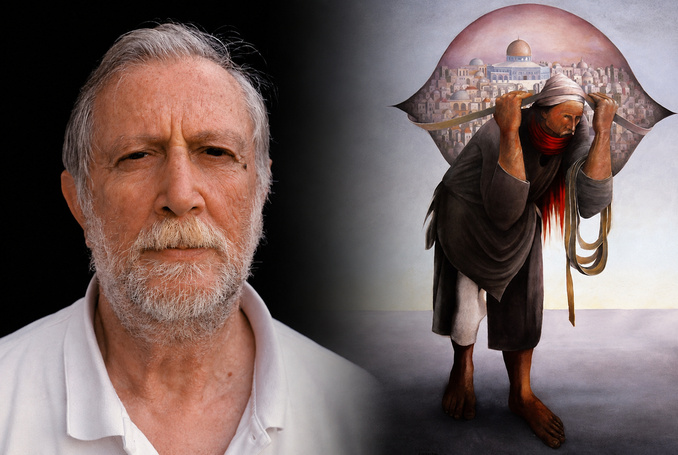

Iconic Palestinian artist Sliman Mansour, whose work transformed land, displacement and steadfastness into enduring symbols of Palestinian identity, has died at 79.
Key Takeaways
- Palestinian artist Sliman Mansour died on Monday after a career spanning more than five decades.
- One of the founders of the contemporary Palestinian art movement, Mansour centered Palestine’s land, people, heritage and collective memory throughout his work.
- His 1973 painting The Camel of Hardships, depicting an elderly Palestinian carrying Jerusalem on his back, became an iconic representation of Palestinian displacement and steadfastness.
- During the First Intifada, Mansour co-founded the “New Vision” movement, whose artists boycotted Israeli art supplies and instead worked with Palestinian materials including clay, wood, leather and natural pigments.
- Mansour described art as a means of “rehumanizing” Palestinians, saying in 2024: “In my art, there is no message of hate. It’s beauty and love.”
‘The Final Chapter Has Been Written’
Renowned Palestinian visual artist Sliman Mansour died on Monday, leaving behind a body of work that helped define the visual language of Palestinian identity, memory and resistance for more than half a century.
“The final chapter has been written,” Mansour’s family said in announcing his death. “With hearts heavy beyond words, we share that our beloved father has passed away.”
“To the world, he leaves behind a life filled with beauty, memory, and a legacy that will continue to live through all those he touched,” the family added.
Funeral and memorial arrangements will be announced later.
Mansour, a painter, sculptor, writer and cartoonist, was born in Birzeit, near Ramallah, in 1947. He became one of the foundational figures of contemporary Palestinian visual art, producing hundreds of works that documented Palestinians’ relationship with their land, displacement, occupation and cultural heritage.
His paintings repeatedly returned to Jerusalem, olive trees, orange groves, Palestinian villages, traditional embroidery and the human figures whose lives embodied the Palestinian experience.
Iconic Palestinian artist Sliman Mansour passes away at 79
——
Sliman Mansour, widely celebrated as a foundational pillar of contemporary Palestinian art, has passed away at the age of 79. His family announced the passing in a statement on social media, writing that the final… pic.twitter.com/RN7LbtFvJl— The Cradle (@TheCradleMedia) August 25, 2026
‘The Land is My Main Inspiration’
For Mansour, Palestine was not simply the geographical setting of his work. The land itself was among his central subjects.
“Everybody is fighting about the land, and the land is my main inspiration,” Mansour told Anadolu news agency in a 2024 interview.
His visual vocabulary drew heavily from Palestinian daily life and heritage: farmers working their land, elderly men and women, traditional homes, olive trees, embroidered dresses and the landscape itself.
Palestinian women occupied a particularly important place in his work, appearing as peasants, mothers, grandmothers, intellectuals and resistance figures.
But Mansour also drew inspiration from a far broader artistic inheritance, incorporating influences from Canaanite, Pharaonic and Assyrian art, alongside Arab and Islamic traditions, calligraphy and ornamentation.
The result was an artistic language rooted unmistakably in Palestine while communicating themes of exile, dispossession, resistance and belonging to audiences far beyond it.
The Man Carrying Jerusalem
No image became more closely associated with Mansour than The Camel of Hardships, first created in 1973.
The painting depicts an elderly Palestinian man bent forward under the weight of Jerusalem, which he carries on his back.
Houses, religious sites, and the city itself rise above the old man as he struggles beneath their weight.
The image came to symbolize a Palestinian people carrying their homeland with them through occupation and displacement and became one of the most recognizable works in modern Palestinian art.
Its significance extended far beyond galleries. Reproduced across posters, publications and Palestinian cultural spaces, the image entered the collective visual memory of Palestine, transforming the burden carried by one elderly man into a representation of an entire people’s relationship with their homeland.
Palestinian artist Sliman Mansour has just passed away. May he rest in peace. pic.twitter.com/SDK1HkhY9o
— Mosab Abu Toha (@MosabAbuToha) August 24, 2026
Art Made from the Palestinian Land
Mansour’s artistic resistance took a particularly tangible form during the First Intifada, which began in 1987.
As Palestinians boycotted Israeli products, Mansour and fellow artists Vera Tamari, Nabil Anani and Taysir Barakat began questioning their own dependence on Israeli-manufactured art supplies.
Together, they formed the “New Vision” group.
“Artists, in turn, boycotted Israeli art materials,” Mansour later recalled. Instead, they turned to materials available in their own environment, including “wood, leather, clay, henna, and natural colors.”
For Mansour, the change was more than a practical response to the boycott. It transformed the artistic process itself.
Palestinian art could now literally emerge from Palestinian soil.
“This new approach helped develop Palestinian art and formed a link between the Palestinian art produced for several decades after the Nakba and the contemporary art produced by young Palestinian artists,” he said.
safe passage to the great Sliman Mansour, revolutionary artist of unparalleled spirit and steadfastness pic.twitter.com/5DWWhbz5LY
— 🔻 (@atlajala) August 24, 2026
Steadfastness, Women and Memory
Among Mansour’s other significant works was Patience and Hope, completed in 1976.
The painting brought together figures representing different Palestinian generations, using them to explore continuity, cultural inheritance and steadfastness.
In Desert Melodies from 1977, Mansour depicted two Palestinian women in traditional clothing in a barren landscape, one playing a flute – an image of beauty and cultural persistence amid hardship.
His 1989 work Rituals Under Occupation, meanwhile, depicted a mass Palestinian funeral, confronting the violence and collective grief of life under Israeli occupation.
Across these works, Mansour developed a recurring language of steadfastness without reducing Palestinian existence solely to suffering.
The embroidered dress became memory. The olive tree represented rootedness. The elderly Palestinian body carried history. Jerusalem represented both place and belonging.
His art documented political struggle while insisting that Palestinian identity also consisted of beauty, culture, family, memory and ordinary human life.
‘Our Role is to Rehumanize the Palestinian People’
That human dimension remained central to Mansour until the end of his career.
In his 2024 interview with Anadolu, he described one of the fundamental purposes of Palestinian cultural production as resisting the dehumanization of Palestinians.
“As artists and people who deal with culture, it’s our role to rehumanize the Palestinian people,” Mansour said.
His message to Palestinians living outside their homeland was equally simple: “Don’t forget Palestine and Palestine is beautiful.”
Despite decades of producing art shaped by dispossession, occupation and resistance, Mansour rejected hatred as the foundation of his work.
“In my art, there is no message of hate,” he said. “It’s beauty and love.”
Mansour received numerous honors during his career, including the UNESCO-Sharjah Prize for Arab Culture and the Nile Award for Arab Creators. His works have been exhibited internationally and are held in museums and private collections around the world.
(PC, QNN, Al-Jazeera, AA)



Great artist. To me he was THE painter of Palestine.