
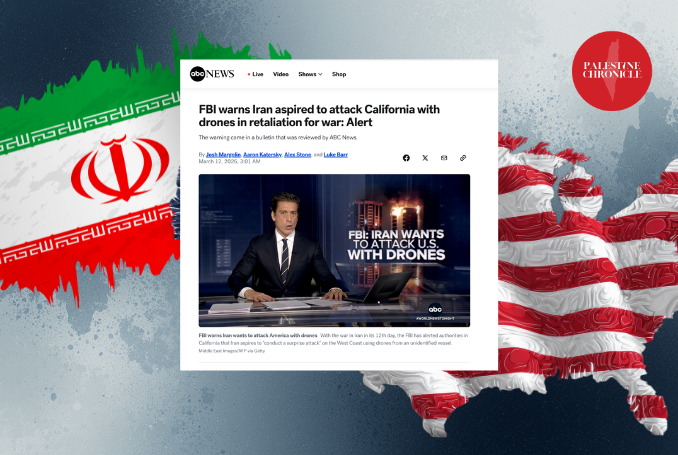

Reports warn of hypothetical Iranian drone retaliation on the US West Coast, yet evidence shows Tehran’s response remains regional.
Key Takeaways
- US media reported an FBI alert warning of a hypothetical Iranian drone attack scenario targeting California or the US West Coast.
- Officials cited in those reports stressed the intelligence was precautionary and lacked concrete operational evidence.
- Iran has focused its retaliation on regional targets, including Israeli sites and US military assets in the Middle East.
- Polling indicates only about a quarter of Americans support the war with Iran, limiting political space for escalation.
- Analysts warn narratives portraying Iran as a direct US threat could shape public opinion during wartime.
Is Iran Planning Drone Attacks on California?
As the US-Israeli war on Iran continues to escalate, a series of reports has circulated suggesting that Iran could retaliate with attacks on the United States itself, including hypothetical drone strikes against the US West Coast.
The allegations have generated considerable attention because they imply that the conflict could extend far beyond the Middle East.
Yet a closer examination of the reports behind these claims reveals a far more limited and uncertain picture. Most of the reporting is based on precautionary security alerts rather than verified intelligence indicating that Iran intends to strike the United States.
What the Reports Actually Say
The claims largely stem from media coverage of a law-enforcement bulletin circulated to authorities in California.
On March 11, NBC Bay Area reported that the FBI had warned local law enforcement agencies about the possibility that Iran could attempt a “surprise drone attack” launched from a maritime vessel targeting locations on the US West Coast.
Officials cited in the report emphasized that the information did not constitute a credible or imminent threat, and that the alert was issued primarily as a precaution amid the ongoing war.
On the same day, People magazine reported that the security bulletin described a hypothetical scenario involving drones launched from a vessel. Still, it acknowledged that the advisory did not identify specific targets or operational timelines.
Rolling Stone, also reporting on March 11, wrote that the FBI warning had been circulated to California authorities amid fears of Iranian retaliation. The magazine noted that the intelligence behind the alert remained unconfirmed and largely speculative.
Similarly, the law-enforcement publication Police1 reported that the advisory urged vigilance but stressed that no concrete intelligence indicated an imminent attack.
Taken together, these reports form the basis of the claim that Iran could strike the United States.
However, none of the reports present evidence that Tehran has developed or announced plans to carry out such operations.
EXPLAINER: Why Iran Is Targeting Radars, Satellites, and Air Defense Systems
Iran’s Military Focus
Iran’s actual military posture in the war tells a different story.
Since the outbreak of hostilities, Iran and its allied forces have already targeted Israeli military sites, US military bases across the Gulf region, and American naval assets operating in and around the Persian Gulf as part of their retaliation against the US-Israeli assault.
Iranian missile and drone operations have been directed at what Tehran considers legitimate military targets linked directly to the war.
Statements from Iranian officials have reinforced that strategic focus. Iranian leaders have repeatedly said that US military forces in the Middle East, Israeli infrastructure, and military assets involved in attacks on Iran will continue to face retaliation.
However, there is no publicly documented statement by Iranian officials threatening attacks on the US mainland.
Military analysts note that this approach reflects Iran’s longstanding strategy of regional asymmetric deterrence, which centers on targeting US forces and allies in the Middle East rather than projecting military operations across the Atlantic or Pacific.
Public Opinion and the War
The domestic political environment in the United States also helps explain why these reports have attracted attention.
Public support for the war remains limited. A Reuters/Ipsos poll published March 3 found that only 27 percent of Americans supported US strikes on Iran, while 43 percent opposed them and the remainder were undecided.
Other polling points to similar skepticism. A YouGov survey released March 5 found that a majority of Americans opposed sending US troops to fight Iran directly, reflecting widespread concern about another prolonged war in the Middle East.
These numbers impose clear political constraints on further escalation. Large-scale military expansion, including a potential ground invasion of Iran, would likely require far broader domestic support than currently exists.
EXPLAINER: The Hidden Costs of the Iran War and US Strategic Miscalculation
The Power of Threat Narratives
In such circumstances, narratives portraying foreign adversaries as direct threats to American national security can become politically significant.
Historically, similar narratives have played a decisive role in building public support for war.
The most striking example remains the run-up to the 2003 US invasion of Iraq, when repeated claims that Saddam Hussein possessed weapons of mass destruction and posed a direct threat to the United States were used to justify the invasion. Those claims were later proven false.
More recently, similar allegations have surfaced in debates about Iran and its regional allies.
Some political commentators have warned that groups such as Hezbollah or Hamas could infiltrate the United States through migration routes along the southern border.
However, migration and security studies have found no verified evidence that such organizations operate infiltration networks across the US-Mexico border.
Why These Claims Matter
The appearance of reports suggesting that Iran could strike the United States, therefore, raises an important question: why are such claims gaining traction now?
One explanation is that intelligence agencies routinely prepare for worst-case scenarios during wartime and issue alerts even when the underlying intelligence is incomplete.
But the reports also exist within a broader strategic and political context.
Revealed: What Really Happened in Iran’s Drone Strike on US Forces in Kuwait
If Iran can be portrayed not only as a regional adversary but also as a direct threat to American national security, the narrative surrounding the war could shift dramatically.
Historically, fears of attacks on US territory have been among the most powerful drivers of public support for military escalation.
At present, however, the available evidence suggests that the war remains largely confined to the Middle East.
Iran’s military actions continue to focus on Israeli targets, US bases in the region, and naval operations linked to the conflict in the Persian Gulf.
Despite the speculation surrounding recent reports, there is currently no credible evidence that Iran intends to expand the conflict to attacks on the United States itself.
(The Palestine Chronicle)





The most likely attack in the US would be from Israelis. It serves their purposes to generate fear and revenge in the US.
1) They want US money and US soldiers for their wars.
2) They have full access to the US throughout all institutions.
3) They have a history of terror attacks for political gains.
If they did it would be with the cooperation of the US’s current administration. Trump hates California, the power the state has, the economy they have, & their majority dislike of Trump and his administration. An attack by “Iran” if people actually believed it was Iran would see major support increase for the war. Such as after pearl harbor or 9/11. They’re so incompetent though that I doubt if they were even able to succeed at a false flag attack on California that people would even believe it at this point. Our own intelligence reports shows Iran’s lack of capability to hit the mainland US as well as the lack of interest.
Actually, the “intelligence reports” of your country are not very adequate to begin with. They screw up quite frequently. Moreover, they try to make Iran’s military capabilities appear much less than what they really are.
Iran, last year, claimed to have conducted a successful test of a new long-range ballistic missile, which travelled over 10,000 kilometers, from Iran into the deep part of Siberia. Therefore, if that’s really true, then, Iran would now have the capability of hitting any target on the east coast of the United States. But, of course, Iran has no interest in attacking civilian sites inside the United States.
p.s. Palestine Chronicle should get its language straight. “Attacks on the US itself” means hitting military targets and reducing their threat.
When you really mean “attacks on civilians”, you should say that! It should not be so normal to hit schools and hospitals that we confuse war crimes with real war. Attacking bases and ships and jets and fuel and barracks are full-on war. Attacking civilians to terroize them is war crime.
They wouldn’t do that. And if they did they would attack strategic military targets in Washington DC, and Virginia.
K nailed it!
The big lie came from Trump – not the “FIB”. Donald, flailing to justify the attack on Iran, lied “Iran gots a ICBM!!!” Probably confused Iran with North Korea.
The likelihood of a false flag attack within the United States will increase as the prospect of “winning” recedes further up the escalatory ladder while popular support declines. Whether a major strike is carried out by Israel or the American government is of secondary importance- they are joined at every level of planning and action. But the notion that Iran aims to attack California would seem to coincide with the MAGA view that the state is filled with traitors and deserves some form of retribution. Trump’s supporters can be expected to derive a delicious sense of irony in seeing a bastion of liberal subversion attacked by the very country Californians defend with their protests.
Because of the all-out U.S. bombing campaign of civilians inside the Iranian homeland (such as its first strike on Iran, which happened to be the bombing of that elementary school in Minab, which massacred around 170 Iranian little girls), wouldn’t Iran have every right to retaliate back and bomb civilian sites inside the United States? Of course, it would! However, Iran is most definitely not seeking to do that, even though the U.S. is deliberately bombing civilian sites all over the Iranian homeland.
If there ends up being an attack against civilians inside the United States, it will have been “Israel” who did this, in a desperate attempt to have Iran be accused of this, and, to therefore force the U.S. to send all of its ground forces into the Middle East, for an all-out invasion of Iran.