
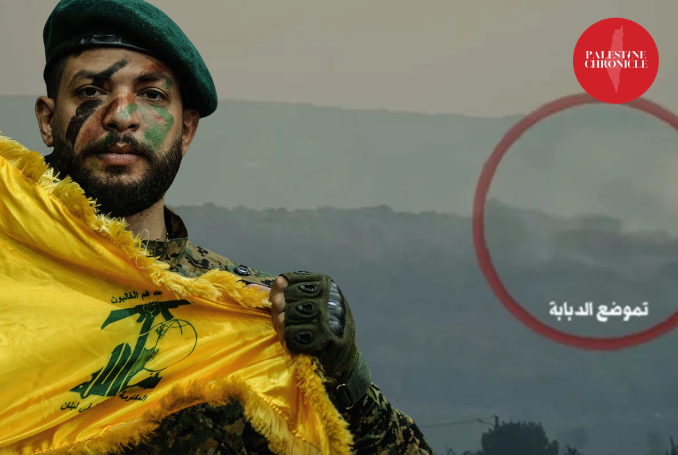

Hezbollah launched rockets, drones, and anti-tank missiles at Israeli occupation military sites, saying the operations respond to ongoing Israeli attacks.
Key Developments
- Hezbollah launched rockets at Ma’ayan Baruch in the Upper Galilee in retaliation for Israeli strikes on Lebanon.
- Drone swarms targeted the Meron base and Ramat David airbase, with claimed damage to radar and command sites.
- Multiple Merkava tanks were hit in Kfarkela and Kfar Shouba with guided missiles.
- Hezbollah said it downed an Israeli drone over Nabatieh.
- Israeli airstrikes intensified across southern Lebanon and Beirut’s southern suburb amid ground advances.
Rocket Salvos
Hezbollah announced a series of operations on Tuesday targeting Israeli military sites in northern occupied Palestine and the occupied Syrian Golan, describing the attacks as a direct response to continued Israeli aggression against Lebanese towns and Beirut’s southern suburb.
In its fourth statement of the day, the Lebanese resistance group said that at 10:50 a.m. it launched a rocket salvo at the Ma’ayan Baruch site in the Upper Galilee. The group stressed that the operation came “in response to the criminal Israeli aggression” that has struck dozens of Lebanese cities and villages, including the southern suburb of Beirut.
Earlier, Hezbollah said it had carried out a large rocket barrage against the Nafah base in the occupied Syrian Golan. The base serves as the headquarters of the 210th Bashan Division.
Israeli media reported that sirens sounded across parts of the Upper Galilee and the northern Golan amid fears of further rocket and drone infiltration. Channel 12 said four people were injured following a direct rocket strike on a building in the Upper Galilee.
Yedioth Ahronoth reported that Hezbollah launched at least 15 rockets toward northern Israel during one of the morning barrages.
The cross-border fire came as Israeli forces intensified airstrikes and issued evacuation orders for dozens of villages in southern Lebanon, in what Israeli officials described as preparations for expanded military activity.
Israel Launches Ground Incursion in Lebanon as Hezbollah Targets Military Bases
Drone Swarms
Hezbollah also announced a series of drone operations against strategic Israeli military facilities.
At dawn, the group said it targeted radar positions and control rooms at the Ramat David airbase in northern occupied Palestine using a swarm of attack drones. The base is considered one of Israel’s key air force installations in the north.
In a separate statement, Hezbollah said it deployed a swarm of “attack drones” against the Meron base for surveillance and air operations management in northern occupied Palestine. According to the group, the operation damaged one of the base’s radars and a command building inside the facility.
The resistance group framed the drone operations as part of a broader response to what it described as 15 months of continuous Israeli aggression against Lebanon, “with killing, destruction, and bulldozing and all forms of crime.”
Israeli media reported repeated drone alerts in northern areas, with sirens sounding in Nahariya and Ras al-Naqoura amid fears of infiltration by unmanned aerial vehicles launched from Lebanon.
The Israeli army said it intercepted several drones launched from Lebanese territory, while also confirming that its air force was carrying out renewed strikes in Beirut’s southern suburb and southern Lebanon.
Israeli-US Strikes Hit Media in Beirut, Hospitals in Iran as Civilian Toll Mounts
Direct Engagement
On the ground, Hezbollah announced multiple direct engagements with Israeli armored units in southern Lebanon.
In one operation, the group said its fighters targeted a Merkava tank at the Al-Samaqa site in the occupied Kfar Shouba Hills at 2:45 p.m., scoring a direct hit.
Later, Hezbollah stated that after monitoring Israeli army movements in the Tel Nahas area on the outskirts of the Lebanese town of Kfarkela, its fighters struck a Merkava tank at 3:00 p.m. with guided missiles, achieving a direct hit.
According to the group, when Israeli forces attempted to advance to retrieve the damaged tank, two additional Merkava tanks were targeted with guided missiles as they moved in succession to pull back the first vehicle. Hezbollah said the strikes forced Israeli forces to evacuate casualties under heavy smoke cover.
Earlier in the day, Hezbollah announced that it had downed an Israeli drone over the city of Nabatieh in southern Lebanon at 12:30 p.m. using what it described as “appropriate weapons.”
These operations took place amid reports from Lebanese security sources that Israeli ground forces had advanced several hundred meters into areas near Kfarkela and al-Qouzah in southern Lebanon.
LIVE BLOG: Massive Explosion in Israel, Tehran Bombed, Strait of Hormuz Closed – Day 4
Cross-Border Escalation
Hezbollah reiterated in its statements that its operations are linked to continued Israeli strikes on Lebanese territory and that “aggression without response cannot continue.”
The group said it had repeatedly warned that assassinations and destruction would not go unanswered, adding that the required course of action was to “put an end to the aggression by all available means.”
The escalation on the Lebanese front unfolded as Israeli forces launched simultaneous strikes on Tehran and Beirut, according to Israeli military statements, and as regional tensions intensified across multiple theaters.
Lebanon’s Health Ministry reported that Israeli attacks since Monday had killed at least 40 people and wounded 246, with extensive airstrikes targeting Beirut’s southern suburbs, the Bekaa Valley, and areas in southern Lebanon.
Israeli officials, including Defense Minister Yisrael Katz, said the army had been authorized to advance and take control of additional strategic areas inside Lebanon.
As air raid sirens continued to sound across northern Israel and Israeli airstrikes persisted in Lebanon, Hezbollah maintained that its rocket, drone, and anti-tank operations form part of a sustained response to what it describes as ongoing Israeli aggression against Lebanon.
(PC, Al-Mayadeen, Lebanese Media, Israeli Media)



