
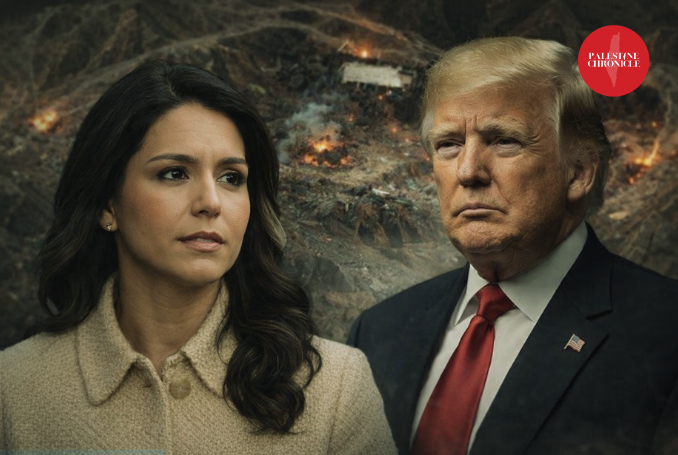
By Palestine Chronicle Editors
Gabbard’s testimony reflects tension between intelligence reality and political messaging, exposing contradictions shaping US narrative on Iran war.
Key Takeaways
- Gabbard’s phrasing reflects a balance between intelligence assessments and political expectations from the Trump administration.
- Contradictions between “obliteration” claims and Iran’s continued capability expose gaps between narrative and reality.
- The testimony highlights how intelligence is framed to align with policy during wartime.
The controversy surrounding US Director of National Intelligence Tulsi Gabbard did not begin with her March 18, 2026, testimony before the Senate Intelligence Committee—it preceded it.
In March 2025, Gabbard told Congress that the intelligence community “continues to assess that Iran is not building a nuclear weapon,” a position later publicly dismissed by President Donald Trump, who insisted she was “wrong” and that Iran was “very close” to acquiring one, as Reuters reported at the time.
That earlier clash established a pattern: when intelligence assessments diverge from political priorities, they are not necessarily overturned—but they are reframed, pressured, or selectively emphasized.
It is within this context that Gabbard’s latest testimony must be read.
What Did She Actually Say—and What Did She Avoid Saying?
Testifying on March 18, Gabbard presented what she described as the intelligence community’s official assessment of the war that began on February 28.
Her central formulation was that “the regime in Iran appears to be intact but largely degraded due to attacks on its leadership and military capabilities,” as CBS News reported from the Senate hearing.
This phrasing is precise, but also revealing. The acknowledgment that Iran remains “intact” challenges any claim of collapse. Yet the addition of “largely degraded” supports the narrative of military success.
Equally important was what she did not say.
In her written statement, Gabbard asserted that Iran’s nuclear enrichment program had been “obliterated.” That language, however, was not included in her spoken opening remarks. Under questioning from senators, she confirmed that the intelligence community’s assessment was that the program had been “obliterated” and that there had been no effort to rebuild it, as CBS News reported.
The omission itself became part of the controversy, with Senator Mark Warner suggesting that the excluded language contradicted the president’s framing of the war.
What Does “Intact but Largely Degraded” Really Mean?
The phrase at the center of the testimony is not merely descriptive—it is interpretive.
It acknowledges a structural reality: Iran, as a state, remains functional. Its institutions persist, its leadership continues, and its regional reach has not disappeared.
At the same time, the term “largely degraded” introduces a conclusion that is less precise and more politically adaptable.
Gabbard elaborated by stating that Iran’s “conventional military power projection capabilities have largely been destroyed,” while also acknowledging that Iran and its allies “remain capable of and continue to attack US and allied interests in the Middle East.”
The contradiction is evident. A state that retains the ability to conduct sustained military operations cannot be easily categorized as strategically neutralized.
The phrase, therefore, operates less as a fixed assessment and more as a bridge between competing interpretations.
Is This Intelligence or a Political Message?
At the outset of her testimony, Gabbard stated that her remarks “convey the intelligence community’s assessment… not my personal views,” as reported by CBS News.
Yet the structure of her statements suggests a careful calibration.
She confirmed that Iran remains capable of military response. She also reaffirmed—under questioning—that its nuclear program had been “obliterated.” At the same time, she avoided drawing conclusions about whether Iran posed an imminent threat.
Instead, she stated that “it is not the intelligence community’s responsibility to determine what is and is not an imminent threat… that is up to the president.”
This is a critical shift. It places one of the most consequential judgments—whether war is justified—not within intelligence, but within political authority.
In doing so, the testimony reflects not only what intelligence says, but also what it is permitted to say.
How Do Claims of “Obliteration” Coexist with Continued Capability?
One of the central tensions in the testimony lies in the coexistence of two claims.
On one hand, Gabbard confirmed—during Senate questioning—that the intelligence community assessed Iran’s nuclear enrichment program had been “obliterated” and that no rebuilding had taken place. On the other hand, she acknowledged that Iran “maintained the intention to rebuild” and continues to possess operational military capabilities, according to CBS News.
This duality mirrors a broader pattern in wartime narratives, where tactical success is presented as strategic resolution.
Yet even within the Senate hearing, this contradiction surfaced. Senator Michael Bennet noted that while Iran’s nuclear program had been damaged, it still retained a uranium stockpile and that the war itself was “not ending, it is escalating.”
The gap between destruction and persistence is not incidental—it is central to understanding the limits of military claims.
What Should We Expect Next?
If the March 18 testimony reveals anything, it is that the narrative of the war remains unsettled.
On one side, there is a consistent effort to frame the campaign as a success. On the other, there is continued acknowledgment of Iran’s resilience, both institutionally and militarily.
The resignation of National Counterterrorism Center Director Joe Kent on March 17—after stating that Iran posed “no imminent threat”—further exposed internal divisions. Gabbard’s response that such determinations rest with the president reinforced the political framing of the issue.
What emerges is not a single, coherent narrative, but a layered one: a war described as effective, yet ongoing; a state described as degraded, yet operational; an intelligence assessment that informs policy, but ultimately yields to it.
In this context, the key question is not whether contradictions exist—they clearly do.
It is whether they can continue to be sustained without fundamentally reshaping the credibility of the narrative itself.
(The Palestine Chronicle)




” Saudi Arabia, Qatar, the UAE, and Kuwait announce measures to intercept and counter Iranian missiles and drone attacks. ” …
but most of those were false flag attacks so that Iran would be blamed. Iran already reached out and said they wouldn’t attack those countries. So who is attacking?
Wasrael.