
Israeli occupation forces continue ceasefire violations in Gaza, expanding the Yellow Line, displacing civilians, and deepening a humanitarian and health crisis as famine warnings intensify.
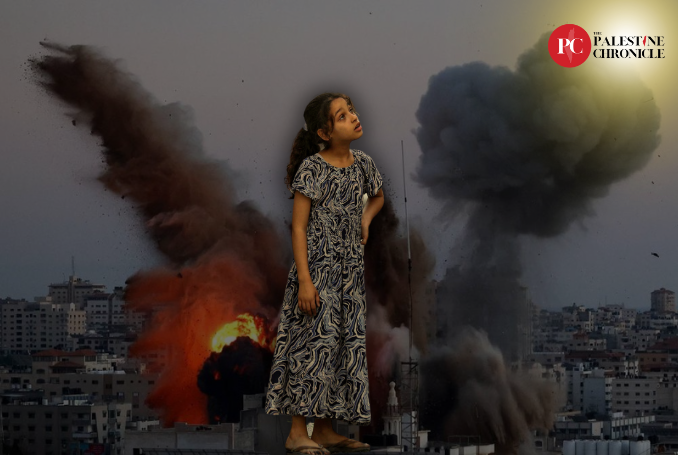
Israeli occupation forces continue to violate the ceasefire agreement through renewed aerial and artillery bombardment across multiple areas of the Gaza Strip, as international organizations warn that famine is once again threatening the population.
Al-Araby TV reported that Israeli aircraft carried out an airstrike targeting a residential area east of Deir al-Balah in central Gaza, near what is known as the Yellow Line, areas seized by the occupation and designated as a security zone.
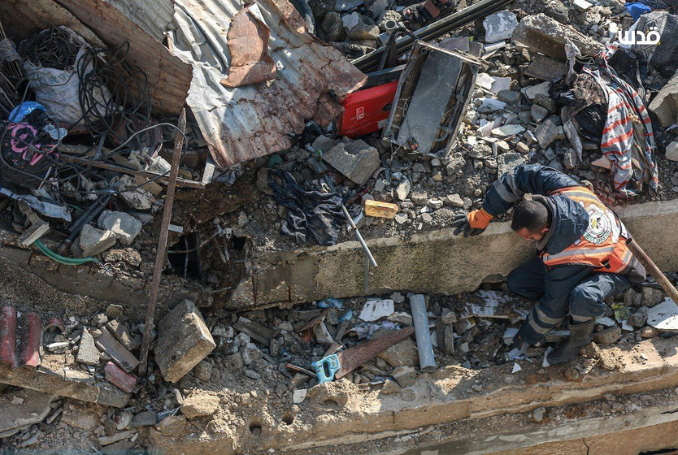
The report added that Israeli forces opened fire on eastern Gaza City and the al-Tuffah neighborhood, while conducting extensive demolition operations on residential buildings east of Khan Yunis in the southern Gaza Strip.
Expansion of the Yellow Line
Al-Araby reported that the most significant development has been the expansion of the so-called Yellow Line in Jabaliya refugee camp in northern Gaza, where Israeli military vehicles advanced and reinforced elevated military positions.
The move has forced residents living in tents or amid the rubble of destroyed homes to flee toward western areas.
55,000 Families Affected as Winter Storms Batter Displacement Camps in Gaza
According to the report, the occupation aims to transform these areas into forward military positions for launching attacks and targeting Palestinians, using both drones and elevated armored vehicles that now overlook and control large parts of the Gaza Strip.
Famine Threatens Gaza Again
On the humanitarian front, international organizations have warned that famine is once again looming over Gaza due to ongoing Israeli restrictions on the entry of humanitarian aid.
The United Nations Relief and Works Agency (UNRWA) said conditions in Gaza remain catastrophic, with humanitarian needs at extreme levels. The agency stated that around 1.6 million Palestinians are facing severe food shortages.
UNRWA media adviser Adnan Abu Hasna told Al-Araby TV that food insecurity remains widespread, noting that approximately one million Palestinians are currently suffering from acute food insecurity.
The International Rescue Committee also warned that hunger in Gaza remains at catastrophic levels, with nearly 100,000 people living in famine-like conditions. The organization said hundreds of thousands of children are experiencing acute malnutrition, posing serious risks to their health, immune systems, and cognitive development.
Shuruq al-Aila, media officer for Save the Children in Gaza, said the humanitarian disaster has not ended despite the ceasefire. Speaking to Al-Araby TV, she stressed the urgent need for mobile housing and winter clothing, particularly for children, amid severe cold weather.
Genocide by Other Means: Palestinian Babies Murdered by Exposure, Not Bombs
Worsening Health Crisis
Meanwhile, Doctors Without Borders warned that new Israeli measures requiring international NGOs to re-register could deprive hundreds of thousands of people in Gaza of life-saving healthcare by next year.
The Palestinian Medical Relief Society also warned of mounting health complications among patients with chronic illnesses due to medication shortages and Israel’s continued restrictions on medical travel. The society’s director, Muhammad Abu Afash, said that 1,200 patients have died as a result of unavailable treatment and the denial of permission to travel abroad, without specifying the time frame.
Separately, the World Health Organization’s director-general, Tedros Adhanom Ghebreyesus, said that 1,092 patients died in Gaza while awaiting medical evacuation between July 2024 and November 2025.
Medical evacuations continue at a slow pace as Israel maintains strict restrictions on patient exits, despite severe shortages of medicines and equipment in Gaza’s hospitals.
On Sunday, Gaza’s Ministry of Health warned of a critical deterioration in drug stocks, reporting shortages of 52 percent of essential medicines and 71 percent of medical supplies. The ministry said Israel is allowing less than 30 percent of the monthly medical aid required into the Strip, violating commitments under the ceasefire that came into effect on October 10.
(PC, Al-Araby)