
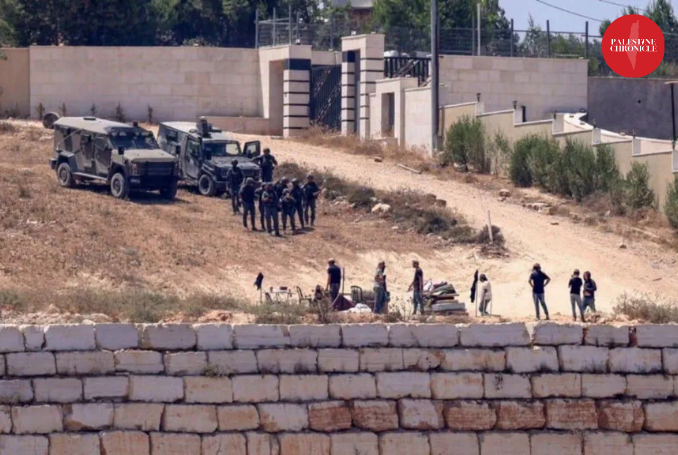

For eight days, Palestinian families in Qusra have faced a settler siege that has evolved into an Israeli military occupation of their neighborhood.
Key Developments
- Israeli settlers have besieged three Palestinian homes in Qusra for eight days.
- Families have faced blocked roads and cuts to water and electricity as settlers seek to establish an outpost nearby.
- Israeli forces intervened but subsequently seized Palestinian homes, with 16 reportedly converted into military positions.
For eight days, three Palestinian families in the occupied West Bank town of Qusra have been fighting for something extraordinarily ordinary: the ability to remain in their own homes.
Israeli settlers began surrounding three houses in the Ras al-Ain area, south of Nablus, last Sunday. They blocked the roads leading to the properties, restricted residents from entering or leaving and cut their water and electricity.
By Sunday, August 16, the siege had entered its eighth consecutive day.
Israeli military forces remained deployed around Qusra, with additional reinforcements sent into the area that morning, according to Quds News Network.
Municipal workers have managed to restore electricity to the besieged homes. Water, however, remains cut.
When municipal crews attempted to repair damaged infrastructure on Saturday, settlers attacked two workers. Israeli forces then detained three members of the municipal team for a period of time.
What began as another settler attempt to establish an illegal outpost has consequently developed into an increasingly complicated confrontation involving settlers, Palestinian families and an expanding Israeli military presence.
At its center are three homes. And the question of whether the Palestinians who own them will be allowed to continue living there.
Palestinians say that an attack by Israeli settlers impeded an attempt by workers of Qusra municipality to fix water and electricity service problems in houses that have been besieged in the northern occupied West Bank. https://t.co/urA4GRPILN pic.twitter.com/2tu5QKhJTd
— Arab News (@arabnews) August 16, 2026
A Tent outside the Front Door
The confrontation did not begin with a formal eviction order. Settlers simply began establishing themselves around the Palestinian houses.
They erected a tent near the three properties, blocked the roads connecting them to the surrounding area and prevented residents from moving freely.
For relatives and people attempting to deliver essential supplies, reaching the families became increasingly difficult.
Among those trapped were the families of Yousef Abd al-Salam and Qusai Abu Rida. The families said attacks in Ras al-Ain had already been continuing for more than four months alongside repeated settler efforts to establish an outpost in the area.
The tent erected outside Abd al-Salam’s home became more than a temporary settler structure.
It effectively determined whether his family could move. Water and electricity disappeared. The road connecting the house with the outside world was blocked.
Nearby, Abu Rida’s family faced the same siege.
Palestinian officials have warned that such pressure could ultimately force the residents to abandon their homes, allowing settlers to take control of the properties and surrounding land.
🇵🇸🇮🇱 Depuis le 9 août, plusieurs familles palestiniennes de Qusra, en Cisjordanie occupée, vivent encerclées par des colons israéliens, privées de nourriture et d’eau potable. La France appelle les autorités israéliennes à arrêter et traduire en justice ces extrémistes juifs… pic.twitter.com/YKldSicVEj
— FRANCE 24 (@FRANCE24) August 14, 2026
Then the Army Came
Eventually, Israeli soldiers arrived. According to the Israeli account cited by Quds News, the military deployment was intended to dismantle an illegal settlement outpost established on Jabal Ras al-Ain.
For the Palestinian families, that might have been expected to end the siege.
Instead, something very different followed. After Israeli forces moved into Qusra, residents of several Palestinian houses were ordered to leave. Soldiers took control of properties and converted them into military positions.
Abdel Azim al-Wadi, head of the Qusra village council, said 16 Palestinian homes in Qusra and its surroundings had been turned into military barracks.
The three families originally surrounded by settlers initially refused to leave.
Eventually, an arrangement was reached under which all three families would be brought together in a single house belonging to Rizq Hassan rather than being removed entirely from the area.
The nature of their predicament had changed. The settlers were no longer the only people controlling access to Palestinian homes. Israeli soldiers were now occupying houses themselves.
Israel Pushes 2,300-Unit Gilo Expansion as Settlers Maintain Siege of Qusra Families
From Settler Siege to Military Control
That sequence lies at the heart of what has happened in Ras al-Ain:
First, settlers surrounded Palestinian homes.
Then the Israeli military arrived, saying it was dismantling the settler outpost.
But the Palestinian families did not simply return to life as it had been before.
Instead, residents were ordered away from homes while Israeli forces assumed control of properties in the area.
And the settlers did not disappear. On August 14, they returned and again erected a tent in front of the same three homes. Israeli forces later demolished it.
By Sunday, settlers were continuing the siege while Israeli troops remained deployed around Qusra.
The families’ electricity had been restored, but their water supply remained severed after the attack on municipal workers attempting to repair it.
Israeli settler militias are letting their cows graze on Palestinian land near the town of Sinjil, north of Ramallah, in the occupied West Bank, as part of a wider colonial strategy aimed at gradually taking over the land. pic.twitter.com/zxo7VK74ex
— Quds News Network (@QudsNen) August 16, 2026
Spain, Britain Condemn Qusra Siege
Events in the small town have now drawn international attention.
Spain’s Foreign Ministry condemned the siege on Sunday, calling for an end to violence and intimidation against Palestinian civilians and accountability for those responsible.
Madrid stressed that Palestinians living under occupation must be protected under international humanitarian law and called for an end to Israeli settlement activity in occupied Palestinian territory.
British Minister of State for the Middle East Stephen Doughty also singled out Qusra while condemning escalating settler violence.
“The shocking, appalling settler violence and settler terrorism we are seeing, yet again, in the West Bank – must end,” Doughty said.
He expressed particular concern over Qusra, where he said Israeli settlers and the army had been laying siege to Palestinian homes, and called for those responsible to be brought to justice.
These demons won’t stop burning, pillaging and killing until they are stopped. pic.twitter.com/jba7ffDPoO
— Darcy (@darcwood7) August 16, 2026
3,488 Settler Attacks in Six Months
Qusra is unfolding against a much broader escalation of settler violence across the occupied West Bank.
According to the Wall and Settlement Resistance Commission, Israeli settlers carried out 3,488 attacks against Palestinians, their communities and property during the first six months of 2026.
The incidents included shootings and physical assaults, attacks on homes, arson, attacks against Palestinian vehicles, land seizures and the establishment of illegal settlement outposts.
The commission said 17 Palestinians were killed by settlers during that period.
At the same time, settlers established 42 new outposts and seized 4,379 dunums of Palestinian land.
Across the occupied West Bank more broadly, Israeli forces and settlers have intensified attacks since October 2023. Palestinian figures cited by Quds News put the toll at more than 1,183 Palestinians killed, around 13,000 wounded and nearly 25,000 arrested.
(QNN, WAFA, PC)





The settlers are scum. It would be best if all of them were removed from Palestine.
To hell with Wasrael.
Free Palestine!