
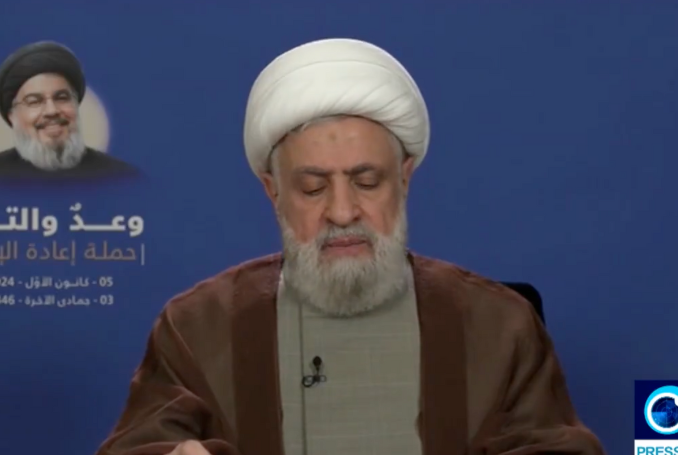
Hezbollah’s Sheikh Naim Qassem condemns US-Israeli pressure, reaffirming the Resistance’s arms as vital to Lebanon’s sovereignty and defense.
In a televised speech marking the first anniversary of the martyrdom of Commander Fouad Shokor, known as Sayyed Mohsen, Hezbollah Secretary-General Sheikh Naim Qassem strongly rejected calls for the group’s disarmament.
“Those who call for submitting arms practically demand submitting them to Israel … We will not submit to Israel,” Sheikh Qassem said, asserting that such demands ultimately serve Israeli interests and threaten Lebanese sovereignty.
He attributed the rising tensions to coordinated pressure by the United States and Israel. US envoy Tom Barrack, Qassem explained, had encountered “a unified Lebanese national stance” from Lebanon’s top three officials, who insisted that Israeli aggression must stop before any talks could begin. Qassem described how “Barrack came along with intimidation and threats to annex Lebanon to Syria and expand the Israeli aggression.”
According to Qassem, Lebanon’s president, prime minister, and parliament speaker are committed to rebuilding the country and will not compromise on what he called Lebanon’s “source of strength.” He accused Washington of attempting to weaken Lebanon under the pretense of assistance: “The Americans seek to strip that strength for Israel’s benefit, falsely claiming they want to help.”
Hezbollah Secretary-General Sheikh Naim Qassem declared in a speech today that the Lebanese resistance will never allow Lebanon to become a vassal state of Israel, not even if the entire world stands against it.
“He also said that Israel will never be able to hold Lebanon… pic.twitter.com/vIOs14Bd99— Ibrahim Majed (@ibrahimtmajed) July 30, 2025
Disarmament Serves Israel only
Qassem made clear that Hezbollah’s arms are intended “to resist Israel and serve as Lebanon’s source of strength.” He rejected the notion that disarmament would enhance national security, pointing out that the US demand for Hezbollah to lay down its weapons is meant solely to benefit Israel.
He reiterated that the group had previously expressed a willingness to discuss how its arms might be incorporated into a broader national defense strategy. Nonetheless, he warned that such discussions cannot occur under pressure, as they ultimately “serve Israeli interests rather than Lebanon’s sovereignty.”
“We will not accept that Lebanon be annexed to Israel even if the whole world unites against us, and we will not accept that it be taken hostage as long as there is a single living soul among us,” Qassem said emphatically.
He went on to question the fairness of the current ceasefire, saying it secured Israeli settlements in the north but failed to guarantee Lebanon’s safety. He added that Israeli attacks, assassinations, and airstrikes continue with the aim of expanding occupation and establishing settlements once Hezbollah is disarmed.
Hezbollah’s Arms Strengthen the State
Qassem rejected claims that Hezbollah undermines the Lebanese state, arguing instead that the Resistance has always bolstered national institutions. He questioned the logic of demanding the group surrender its weapons: “Does the state have the right to say it cannot defend its people, then demand we hand over our weapons only for them to be destroyed by Israel?”
He affirmed Hezbollah’s compliance with the ceasefire agreement and said that linking it to disarmament was unacceptable: “The issue of weapons is purely an internal matter.”
Addressing those pushing for disarmament, Qassem said: “You stop the aggression, ground the warplanes, return the captives, and let Israel withdraw from the territories it has occupied, then, let’s see if the situation stabilizes, and after that, you’ll get the best possible dialogue and the most constructive response from us.”
🇱🇧 Sheikh Naim Qassem:
Bottom line::
Lebanon is not an annex of “Israel”—
and it will never be,
as long as we breathe,
as long as we say: There is no god but Allah. pic.twitter.com/uQ42tuRwfL— 𝑾𝒂𝒉𝒂𝒋 🇾🇪 (@krar_wahaj) July 30, 2025
He also urged the Lebanese state to take charge of reconstruction efforts, regardless of American obstruction or pressure on Arab countries. Reconstruction, he said, must be treated as a national priority and a step toward economic revival.
Calling for unity, Qassem encouraged all Lebanese to embrace a national motto: “Let us drive Israel out through our solidarity and rebuild our homeland together hand in hand.”
Lebanon at a Crossroads
Qassem warned that Lebanon faces an existential threat not only from “Israel” but also from ISIS and the United States, which he said are pushing for a so-called “New Middle East.”
He recalled the origins of the Resistance, which was born to compensate for the army’s limitations and now forms a foundational “trinity of the army, the people, and the Resistance.” This trinity, he argued, is not merely rhetorical, but a proven component of Lebanon’s state-building process.
Sovereignty and Liberation
Qassem explained that Hezbollah’s work follows two paths—resisting occupation and building state institutions through authentic popular representation. Both goals, he said, go hand in hand and should not be seen as mutually exclusive.
He underscored that the Resistance remains active in all arenas—military, social, and political—which is precisely why Israel continues to violate ceasefires, as its military campaign has failed to subdue Hezbollah.
Hezbollah’s Secretary-General stated that Lebanon must choose between two futures: one of sovereignty, independence, and liberation, or one of subjugation through foreign occupation. “Between these two choices, we stand with sovereignty, independence, and liberation,” he said.
Call for Global Solidarity
Turning to Gaza, Qassem denounced Israel’s ongoing war as a genocide, accusing both Tel Aviv and Washington of “committing systematic atrocities daily in the enclave.” He called for unified international opposition to what he described as Israeli tyranny, insisting it is a threat to all of humanity.
Tribute to Martyrs
On the anniversary of Commander Fouad Shokor’s martyrdom, Qassem commemorated his role as a pioneer of the Resistance. Shokor, he said, led one of the earliest fighting cells, the “Covenant Unit,” before 1982. He also served as Hezbollah’s first military commander, founded its naval unit, and played a critical role in martyrdom operations and war logistics.
He worked closely with former Secretary-General Sayyed Hassan Nasrallah until his martyrdom.
"We salute the freed prisoner and fighter George Abdallah, who stood tall for 41 years and refused to sign a document renouncing his beliefs in exchange for a few years."
– Sheikh Naim Qassem 💛🇱🇧🚩 pic.twitter.com/XU3iUCWTVf
— مايا 𓂆🫒 (@AlAndalus074478) July 30, 2025
The speech also honored the legacy of Ismail Haniyeh on the anniversary of his martyrdom, crediting him with elevating the Palestinian cause to the global stage.
Finally, Qassem paid tribute to long-imprisoned Lebanese fighter Georges Abdallah, praising his 41-year resistance from within prison and underscoring his steadfast refusal to abandon his ideals. Abdallah, Qassem noted, remains a vital part of the Resistance’s heritage, uniting the struggle for land with the defense of human dignity.
(PC, Al Mayadeen)



Never back down! The Israeli Nazis are a plague on this Earth, and will not stop until someone stops them.
To hell with Wasrael.
” death, death to the IDF ”
FTRTTSPWBF!