By Benay Blend
Judging from the recent bombing of Caracas, capital of the Bolivarian Republic of Venezuela, along with the kidnapping of its president, the US has learned nothing about the resistance of anti-imperialist movements around the world.
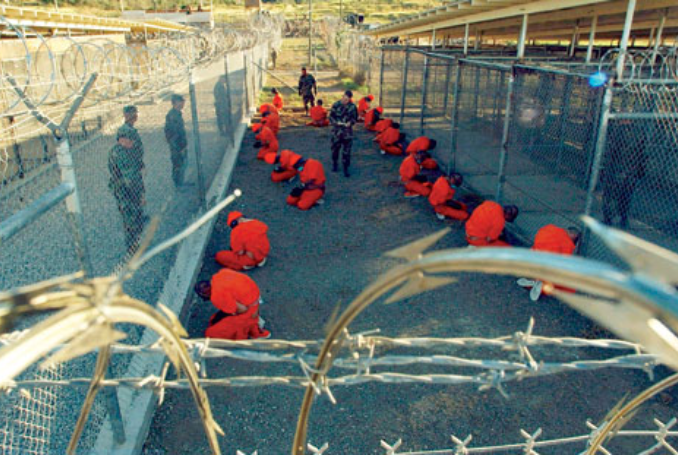
January 11, 2026, marks 24 years of US detention of Muslim men and boys at the Guantánamo Bay prison (GTMO). Like Palestinians held in Israeli jails, most have suffered unjust detention, torture, and abuse, plus GTMO’s brutal and illegal practices are shared by prisons around the world.
For example, Israel’s far-right minister, Itamar Ben-Gvir, is promoting an idea for incarceration based on President Trump’s “Alligator Alcatraz,” a short-lived plan for immigration enforcement located in a swampy, alligator-infested area in Florida.
Undaunted by US court challenges to the prison, Ben-Gvir envisions a prison purposely surrounded by crocodiles, not just present as an act of nature. According to Palestine Chronicle staff, his plan “further entrench[es] Israel’s prison system as a mechanism of psychological and physical coercion against Palestinians.”
Since 1903, the US has retained a naval base at Guantánamo, which served to hold Cubans along with Haitian refugees seeking asylum in the US, Israel, a country founded on settler-colonialism, much like the US, has now escalated its ongoing ethnic cleansing against the Palestinian people. The entity has also intensified violence against prisoners within its detention system, a mechanism of social control and punishment that closely resembles tactics used at Guantánamo Bay.
Thus, Guantánamo prison and Palestine are connected in several ways, including through the incarceration of Palestinian prisoners at the GTMO facility. Commentators have also used the term “Israel’s Guantanamo” to describe Sde Teiman detention camp, a torture center in the Negev Desert that employs human rights abuses similar to GTMO: arbitrary and indefinite detention without access to a fair trial; physical and mental torture; denial of food and water; and inhumane conditions like overcrowding and constant blindfolding.
Adding personal testimony to the mix, Mansoor Adayfi records that his 14-year incarceration at Guantánamo echoes that of a recent CNN report of conditions at Sde Teiman.
“Our ordeals are so similar,” Adayfi writes, “because both Israel and the US believe they can function outside the limitations of international law and do whatever they please to human beings they perceive as a threat in the name of ‘national security.’”
Other testimony from recently released prisoners also attests to brutal treatment, comparable to conditions at Guantánamo prison.
“The Negev Prison is like Guantanamo Bay. Everything is beyond what the mind can imagine,” stated Muazzaz Khalil Abayat, after having endured nine months of daily beatings and torture in Israeli detention centers.
According to the Palestinian Prisoners Society (PPS), brutal assaults included “the breaking of all his limbs,” along with torture and starvation.
“I was stabbed on December 4. I was subjected to attempted murder in Ofer prison, and (Itamar) Ben-Gvir danced on my body,” Abayat said in a video posted by the Institute for Middle East Understanding. “They announced my death on December 4, and I woke up to find myself in Al-Ramla Prison hospital. I didn’t receive any treatment, the situation is horribly bad.”
When the son of Bil’in peace activist Iyad Burnat was released after three years in Israeli prisons, he was left with multiple life-changing injuries. Arrested in retaliation for Burnat’s outspoken opposition to land theft in their community, Mohammed faces several heart surgeries to correct the damage done by Israelis while he was in prison.
As of December 2025, Palestinian human rights groups and the IPS report a total of over 9,300 Palestinian political prisoners in the formal Israeli prison system. This figure does not include Sde Teiman because the Israeli military and government do not disclose the exact number, whereabouts, and status of all Gaza prisoners held in army-run camps like Sde Teiman.
Similarly, when former Guantanamo prisoners see photos of Palestinians being tortured in Israeli jails, they see the same abuse and torture that they endured at GTMO.
“This is the worst form of oppression,” says Asadullah Haroon. “When you are labelled as a terrorist you cannot defend yourself in any way. Without a doubt, it’s the same process; they are torturing the people in the same way. I think the Americans have made this and the Israelis are implementing it.”
Released in 2021, Haroon had been held without charge in the Guantánamo Bay Prison for 16 years.
“Physical torture was really bad,” he states. “But the worst was mental torture in different forms. I believe there isn’t much of a difference in the torture of prisoners of Palestine, Guantanamo, Bagram and Abu Ghraib.”
According to Osama Bin Javaid, much of the abuse filmed by the very Israeli soldiers carrying it out has “strong echoes of the treatment of Iraqi and Afghan prisoners in US detention centres such as the notorious Abu Ghraib prison – where US soldiers photographed themselves alongside prisoners in humiliating positions in 2003.”
Written in 2021, Ramzy Baroud’s “The American Injustice Industry: Why shutting Down Guantánamo is Not Enough” still holds true today. The only thing that has changed is the verb tense. While Baroud writes about what might happen in the future, alas it has already passed, thus replicating a continuous history of imperialist destruction no matter who is president.
“Whether Biden fulfills his promise of shutting down Guantánamo or not,” Baroud asserts, “little will change if the US remains committed to its condescending attitude towards international law and to its undeserved view of itself as a country that exists above the universal rights of everyone else.”
The problem remains, because, as Baroud explained five years ago, “America still refuses to learn from its mistakes.”
Baroud contends that perhaps GTMO remains open in order “to avoid international accountability and, arguably, to extract information by torture, an act that is inconsistent with American laws.”
But this makes no sense, he writes, because the invasions of Afghanistan and Iraq, and now it could be added the bombing of Venezuela, along with the kidnapping of its president, are also illegal under international law.
In the same way that many Americans deny that Trump, in his second term, represents “who we are” as a country allegedly of laws, those same people reject the notion that “[Guantánamo] is a symbol of their country’s intransigence and refuse to accept that, like any other country in the world, it is accountable to international law.”
“Instead, Guantánamo is an industry, and a lucrative one,” Baroud explains. “In many ways, it is similar to the American prison military complex, ironically dubbed the ‘criminal justice system.’”
Even if activists are successful in shutting GTMO down, Baroud concludes, “justice will still be absent, not only because of the numerous lives that are forever shattered but because America still refuses to learn from its mistakes.”
Judging from the recent bombing of Caracas, capital of the Bolivarian Republic of Venezuela, along with the kidnapping of its president, the US has learned nothing about the resistance of anti-imperialist movements around the world.
In solidarity with the people and government of Venezuela, Samidoun Prisoner Solidarity Network notes that “there are two paths for the world: [one is] of the resistance of the people, of Al-Aqsa Flood and the Bolivarian Revolution; and [the other] of the horrific crimes of imperialism and the blatant greed and thievery of the US empire in decline.”
Given that the Empire is in decline, this is a perfect time “to make the first path — the global camp of resistance — larger, stronger, and, indeed, victorious.”

– Benay Blend earned her doctorate in American Studies from the University of New Mexico. Her scholarly works include Douglas Vakoch and Sam Mickey, Eds. (2017), “’Neither Homeland Nor Exile are Words’: ‘Situated Knowledge’ in the Works of Palestinian and Native American Writers”. She contributed this article to The Palestine Chronicle.