By Karan Singh
“To make a movie about the Nakba while you’re watching an even bigger Nakba is absolutely devastating.” – Cherien Dabis
Capturing the history and present-day reality of a lineage while being cut off from its land of origin sits at the heart of creative expression emerging from the Palestinian diaspora. That is precisely why Cherien Dabis came to accept absence and presence as parallel states in bringing her latest film to fruition. Built around the cross-generational aftershocks of the ongoing Nakba, All That’s Left of You zooms in on the inheritance of dispossession and the resilience it yields.
Following the events of October 7, 2023, the cast and crew were unable to shoot the movie in Palestine as originally planned — an interruption that mirrors the broader restrictions that continue to suffocate the indigenous population. At a time when Palestinian voices face heightened scrutiny, Dabis insists on undiluted remembrance by underscoring the power of refusing to disappear. Operating within an industry that often demands restraint, neutrality or outright silence when it comes to Palestinian suffering is no easy task, yet she succeeds in telling that story on her own terms.
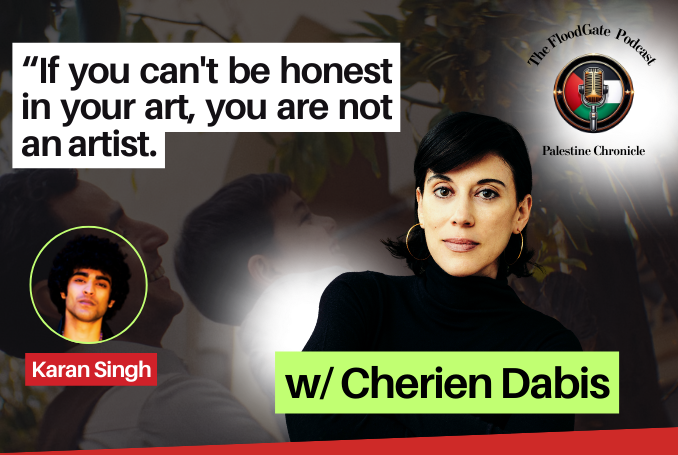
Prior to the theatrical release of All That’s Left of You on January 9, Dabis joined the Palestine Chronicle to discuss artistic integrity, circumventing countless roadblocks and her role in combating erasure.
You’ve always wanted to make a film about the Nakba, but why now? Was there a specific impetus behind your decision to start working on the script or is it just that you’re finally in a place where you can paint that picture without restraint?
I knew that taking on this story was going to be a really big endeavor, and I didn’t want to do it until I felt ready. I really started thinking about it after I made my first two feature films, just to start putting pen to paper.
That was around 2014, when the world was watching Gaza being bombarded again and again. It was another one of those years, so that was something that made me feel ready to tell this collective Palestinian story that is also somewhat like our origin story. I was a broke filmmaker at the time, and I needed television to survive so I could continue making these independent feature films. As I was breaking into television — writing and directing these shows, and then eventually acting — I was also developing this story on the side.
While I was slowly jotting ideas down into a journal, I thought I’m just going to take my time because this is such a big story, so I wanted a long period of research and gestation. It wasn’t until 2020 that I actually sat down to write the script, and it was partly because the entire world shut down during the pandemic. I found myself with long stretches of time, and it just flowed out of me because the story had been marinating for so long.
That’s really the reason for the timing: I had two features under my belt, and I felt ready to tackle something bigger. I always knew this was going to be an epic, sweeping kind of film that would cover a lot of ground, so I wanted to make sure I was ready and that I took my time with it.
Do you think shedding light on the Palestinian condition in its fullness is career suicide for a young filmmaker or any early-career artist? Can having that on your track record get you blacklisted?
I absolutely don’t think that it is career suicide — I think it is necessary to maintain one’s integrity, and you need your integrity to have a career. We’re talking about artists, right? If you can’t be honest in your art, then you’re not an artist. What’s happening in Palestine is perhaps not important to everyone, but if you’re an artist and it is important to you, then you are sabotaging your art by not speaking out. That’s really my point of view.
I just don’t think it’s an option for people who care. I’m not necessarily judging those who stay quiet, but I do think it is a detriment to those who really want to speak up and are too afraid to. I hope they reach a point where that changes, and I think a lot of people have already reached that point. At the beginning of all of this, we were seeing a lot more fear of speaking the truth …
If you put this all in perspective, we could very easily see such a massive shift in a few years, such that if you were one of those people who did not speak up, then you’re blacklisted. Times change, so it comes down to which side of history you want to be on. We just really need to be thinking about the bigger picture all the time, especially as artists, because our job is to change culture — we put things out into the world that impact people. We have to think responsibly about this, and I take this responsibility seriously. I want to put a lot of thought into what I put out into the world, because it has the potential to shape how people think and to shift perspectives. Film and television, especially, are very powerful media. The media absolutely shapes perception and changes narratives.
I don’t personally think a lot about blacklisting. I don’t put any energy into that thought. In other words, if I’m blacklisted, it’s none of my business. If I am, I don’t know and I don’t care. I’ll always find a way to get my work done.
Making the film is one thing, while its visibility is another. Pitching any project on this subject must be a struggle unto itself, so could you talk us through the process of publishing and distributing the film?
I wrote the script in 2020, and I started taking it out into the world in 2021. I was getting a very emotional reaction — people would call and tell me it made them cry. That felt really good, like I had something powerful that people were responding well to, even if they didn’t want to finance it. I only took it to a handful of American production companies because I knew that this wasn’t going to be something that would be financed in the US, unless it was private equity. I mainly took it to European producers and ended up partnering with one pretty quickly. Then, we found European public funding and funding in the Arab world as well, in addition to private equity. Pitching it actually went very well, I would say.
I got a little bit of pushback about how there’s no balance, like I couldn’t tell the story of a Palestinian family without getting that note of “but where’s the Jewish story?” Well, I don’t know because I’m not Jewish; I’m Palestinian, and the story I’m telling is about a Palestinian family. It’s told over multiple generations from their point of view, and most of it takes place in the West Bank, where the only Israelis they encounter are soldiers. At the end of the film, they have a reason to go into Israel proper, where they meet Israeli civilians and you see a wider swath of Israeli society. So there was some pushback during that phase, but I was always able to convince people why I needed to tell the story this way and why it needed to focus on a Palestinian family.
The process can be frustrating sometimes because I’d be getting pushback about things that would just make me go, “Hey listen, this story has never been told. This story really needs to be told.” It’s been erased from the world’s consciousness and is not included in the history books. It is being actively suppressed and denied, and so I think people understood that and got behind it when they realized that the film was full of love and compassion and humanity. Because of that, getting it made and financed was relatively easy.
The distribution is a different story, which has been really challenging in English-speaking territories. We were really hoping for mainstream distribution in the US, and I think that speaks to my team’s faith in the film. I think they felt it was universal and well-crafted like a Hollywood epic, but a little subversive since it’s about a Palestinian family. People really believed in it, so it was quite disappointing when Neon, A24 and all these major distributors passed. Then, I realized that no Palestinian film has ever had major, mainstream distribution, so why am I surprised? Why did we all expect something more? We were watching a genocide, so maybe that’s why, but it turns out that was making people more fearful than ever. I had distributors literally tell me that they were afraid of the subject matter.
It was clear that we were going to have to figure out another way, though we did get boutique distribution offers. I ultimately ended up forming my own distribution company and partnering with Watermelon Pictures, who have been doing remarkable work in this space because they really want to break these movies out into the mainstream. Teaming up with them has been really encouraging, to work toward getting the movie out in as big a way as we can this January.
Hollywood’s reluctance to get behind a film like this is no secret, but you’ve had Mark Ruffalo and Javier Bardem join your team as executive producers. What difference has their involvement made?
The idea behind getting them involved is to raise the profile of the film — to raise people’s awareness of it, taking it out of the margins and into the mainstream. This is a really important story, especially right now. This is a taboo-breaking film about the Nakba in a world that doesn’t really want that story to be told. It shows a process that began decades and decades ago in 1948, and what started then has never ended.
Mark and Javier have huge public profiles, so they can speak publicly about the film in the press or on social media. It helps bridge the gap between this being a mainstream film versus it having any potential mainstream crossover.
Bloodshed is unfortunately what most people associate with Palestine today, but All That’s Left of You focuses more on the domestic, everyday side of that condition. In charting out the narrative, what were some of the questions you were trying to answer as you sought a balance between pain and perseverance?
The world associates Palestine with violence and suffering, which is frustrating as a Palestinian because there’s so much beauty to the culture and the people and who we are. That part is who we are, not the violence and suffering. Finding that balance is very natural and organic for me, because I tell stories that focus on people and families.
In this film, I really wanted to focus on the impact of historical and political events on human beings. How has history shaped the Palestinian people? We don’t ever really get to see that. As much as people may know factually what happened in Palestine, especially in the last couple of years, I think the Palestinian experience is still pretty foreign — how people are shaped by the everyday violence that they experience under occupation. The word “occupation” sounds so benign, but it is something that is so brutally violent. Palestinians have been killed every single day for decades, yet the world has come to expect this level of violence and suffering from the Palestinian people, as if it’s normal.
I wanted to make a movie that was about the impact of these events and how occupation really shapes people. You can see how people change from generation to generation and why the First Intifada erupted in the 1980s, why there was a fiery spirit of rebellion after two decades of occupation.
There’s a deeply moving scene in Mo where your character says, “We’re more than our pain and suffering,” which is a sentiment that shows up quite strongly in this film.
That line is the essence of who I am. As a Palestinian who grew up in the diaspora during the 1980s, I was surrounded by people who knew nothing about Palestinians, Palestine or really even where Palestine was. All people knew about us was the violence and suffering — that’s not my experience of being Palestinian, but that’s not even the experience of a lot of Palestinians in Palestine. People are trying to live their lives despite the violence and despite the suffering, and that is who the Palestinian people are.
I’m just blown away by the sense of humor that people have every time I go to Palestine, almost like a survival mechanism to get them through the difficulty of their lives. The sheer difficulty of just getting to work or sending their kids off to school when there are apartheid walls or checkpoints — there are just so many obstacles. What inspires me most about my own people is their resilience and sense of humor; their profound love of the land and of each other, which is what really keeps them going and allows them to survive everything that they’re enduring.
There’s a critical point in the film where the Palestinian leads make a selfless gesture that illustrates the power of doing the right thing, even though it doesn’t change their fate. With all the death and destruction we’ve seen, where do you personally stand on taking a kinder and more dignified path as opposed to fighting fire with fire?
Look, I’m a person of privilege and I did not grow up under occupation or the threat of violence. I don’t know what my response would be if I had grown up in that type of environment. From the film, my stance is clear in that I personally choose to resist through non-violent means. I choose to resist through my art, through my storytelling, through cinema. Palestinians choose to resist in a myriad of ways, and like the characters in my film, I think a lot of Palestinians resist by choosing humanity — they resist by holding on to who they are, holding on to their love, holding on to their integrity, holding on to their families.
What we often see is violent resistance, and we’ve come to make that synonymous with all Palestinians and all of Palestine. That’s not really the case, but the world doesn’t allow us to see non-violent Palestinian resistance. You know, the First Intifada was largely non-violent. The Great March of Return was non-violent, but the world does not get to see that because the news does not report on it. What the mainstream media wants us to see is Palestinians as violent. That stereotype is what keeps us dehumanized to the degree that we can be killed in such large numbers, and the world kind of justifies that as something that needs to happen to keep other people safe. That is absolutely a lie.
My form of resistance is cinema, and the same goes for Mohammad Bakri — he resisted through his art. I bring him up because he sadly passed away recently, and he was a huge inspiration to so many of us Palestinian filmmakers. I feel so grateful to have worked with him and to have gotten to know him through this film.
The events of October 7 entirely changed the course of the project and essentially forced you to go back to the drawing board since you were no longer able to shoot in the locations you had initially planned. You then began filming as the ongoing crisis in Gaza was escalating, so did that make you change the script in any way?
We had prepped on the ground for five months, and then we had to evacuate two weeks before shooting. At first, as I was watching things escalate, I thought to myself that I might need to change the script. I took a full week to really think about and explore what that would look like. When I have big decisions to make in my life or in my work, I tend to get really quiet — I kind of sit in meditation and wait for an answer to come. When I did that, the answer that came to me was that I had to make the same film, and that even if it’s seen as too gentle, it’s necessary. Its message is needed now more than ever in the world, so I decided to stick to what it was that I was doing.
I say perhaps it could be seen as too gentle because what we’re currently witnessing is so profoundly harsh and destructive and devastating that it makes what happened in the periods of the film look rather gentle in comparison. The movie is a period piece that takes place in 1948, 1978, 1988 and then 2022. In the ’70s and ’80s, things were not as bad as they are today, although way worse things happened than what is depicted in the film. There have been massacres during many different periods of Palestinian history, but that’s not the story I’m telling. I didn’t want to make a violent film, but one about the extraordinary will that it takes to survive tragedy and personal loss. I wanted to focus on these qualities that we discussed already, like the love of family and the resilience of the Palestinian people.
The one thing that did change in the script was that the film was supposed to end in the present day, but because of everything that was going on, I decided against it. I’d have to address way too many things that are currently happening. All the events in the film took place before 2023, and I wanted to tell the story of how we got here. I ended the movie in 2022, thinking that this is the story of what led us to this moment. This is the ongoing Nakba.
To make a movie about the Nakba while you’re watching an even bigger Nakba is absolutely devastating. It was incredibly painful to watch what was unfolding on our news screens while we were recreating similar scenes that happened in 1948, so it was like art and life merging. The intensity of those circumstances really gave the movie more emotional depth and resonance.
Ending the film before 2023 helps put into perspective everything that led up to these events that so many people have been conditioned to view in isolation.
It’s so sad, but if you think about it, there’s a real tendency for human beings to just forget the past. Gaza was bombarded so many times with thousands of Palestinians killed before 2023, and for some reason, the world just kept forgetting. We would have momentary waves of compassion, like in the summer of 2021, but then the Palestinians had been forgotten by the next year.
The filming was scheduled to take place all over Palestine, and you also had access to a lot of historical props dating as far back as 1948. Tell us more about that.
I was there with my local crew, and we actually created a warehouse full of props that we found and crafted and curated. The film is an official co-production between Germany and Cyprus, so I had a lot of foreign crew coming in from Germany as well. We traveled the country, found all our locations and amassed everything into this warehouse. We found all our period vehicles, including a bus from 1948 that actually transported Palestinians fleeing their villages during the Nakba.
We had really done a tremendous amount of work before we had to flee. We ultimately ended up shooting the movie mostly in Jordan, which is why we’re Jordan’s official submission for the Academy Awards. We ended up shooting in the refugee camps in the north of Jordan, which still allowed us to work with the Palestinian refugee community. That was great because it’s essentially their story, so we really wanted to include them in the making of the film.
But yeah, we faced so many obstacles when we had to evacuate. There were logistical and financial challenges — all the money for the film had been spent, and we had to start pre-production all over again. We had to raise a lot more money, figure out where to go and look for our locations all over again, and then also get those props out of Palestine. We had to get them transported first to Cyprus and then to Jordan, and then ultimately to Greece.
The shoot just became multiple countries. It was a producer’s worst nightmare in that there were a lot of logistical complexities and problems to solve. It was really one of the most challenging things I’ve ever done, to be honest. It was 11 months of production because we kept having to stop and raise more money or figure out where to go next or prep our next location, for weeks and weeks at a time. It was definitely not the way that movies are normally made.
That warehouse almost sounds like a museum.
It was in Ramallah, and we were so proud of it. We had so many skilled Palestinian artisans, painters and craftspeople there, building donkey carts from 1948 or painting the walls of the 1980s refugee camp or finding these incredibly rich textiles. Then, we had shelves and shelves of props from all the time periods — phones from 1948 and the 1970s, and also televisions from the ’70s and ’80s — and when you walked in, the place was just lined with these items. Past that, you’d walk into this larger carpentry area where they were building walls and painting them to give them a specific type of texture. My art department actually made rocks out of paper for the Intifada protest, because we couldn’t have extras throwing real rocks and injuring people. We had to make those paper rocks such that they actually felt like they had enough weight but were safe to throw, and they would give off dust when they hit something. We made hundreds of these rocks, and we would put them to the test by throwing them to see if the dust would fly off and if they felt real.
The level of detail we were creating was so beautiful. Everybody was really in it, so it was devastating to leave behind when we had to flee. Not just those beautiful artifacts we had found and the props we were creating, but also to leave our Palestinian crew behind. Everyone was really impacted, but the art department in particular was left in this warehouse of relics with no idea … Is the movie going to continue? Are we going to be working on it? What do we do with all this stuff?
There’s actually a film that follows the people left behind in Palestine. It’s a separate film from mine, and it’s called Unmaking Of. It kind of opens with us prepping in Palestine before October 7, and then it really stays with the art department as they’re kind of abandoned by us. It looks at their deteriorating mental states, because they’re now out of work during a war while watching the total destruction of Gaza. I didn’t make the film, but hopefully they’ll release it around the same time as mine or shortly after.
Being Palestinian and making a film about Palestine, but not being able to film it in Palestine — that sort of encapsulates what All That’s Left of You is about. As someone who grew up in the diaspora, how do you go about capturing the essence of Palestine, the Occupied Territories and the experiences of those living there while having had limited access to the land your entire life?
I had limited access to the physical place, for sure. I grew up visiting, and then I started going back as an adult for work — like my first feature film, Amreeka — and then visiting as often as I could. I had these windows into occupation, but I certainly did not live there or have the experiences of Palestinians living there.
What I do have is a really strong cultural and political foundation. I grew up with parents who were very Arab-proud and very Palestine-proud, and that is what largely enables me to take on these stories. Despite my limitations, I have been able to use my experiences in my work. The humiliation scene that’s at the center of this film is inspired by me seeing my father treated that way as a kid at the border between Jordan and the West Bank while we were attempting to visit our family. I grew up in a community of Palestinians and Arabs who shared similar stories about the Nakba and their families back home all the time. I was drawing from my own experience, from the experience of my father and then from the collective.
I surround myself with people who have that experience and who can help me create something authentic. We did a lot of research, looking at photo archives and film archives, and really just tried to recreate every detail. We don’t really have an ongoing Nakba film, and certainly not one that covers this sweep of history, so I felt a great responsibility for it to be authentic. I needed every detail to be based in reality. In cinema, we see urban Palestine in 1948. You can’t really find public archives of what the inside of people’s homes looked like in Yafa in 1948 or how people dressed in the city. A lot of the archives look at villages or farmers, but I couldn’t find as much on city people.
We did a deep dive, looked into personal archives and talked to people who are from there. For me, making this film was a community effort. Even when we were in Palestine, I really relied on the people there to help me research the details and recreate them. Even after we fled, I was still counting on them because the foundation of our prep was in Palestine. I had all that research and wealth of knowledge that I’d gained there. We even tried to bring as many Palestinian crew members with us to the various locations we shot at to keep that level of authenticity, because there’s an aesthetic difference even between Palestine and Jordan. The tiles are different, the wallpaper, the texture — there are differences in the physical realities inside the homes and in the different types of stones that are used for building.
It was a real education in architecture for me, in how refugee camps evolved and what the architecture of those camps was from 1948 to the present day. I learned so much about the history from an artistic and architectural point of view. I was hungry for that, so this film fulfilled my curiosity and also introduced me to a creative community that I’m just so grateful for. I couldn’t have made this movie without all those incredible people.
(The Palestine Chronicle)
– Karan Singh is an Indian American journalist based in Los Angeles. He contributed this article to the Palestine Chronicle.