
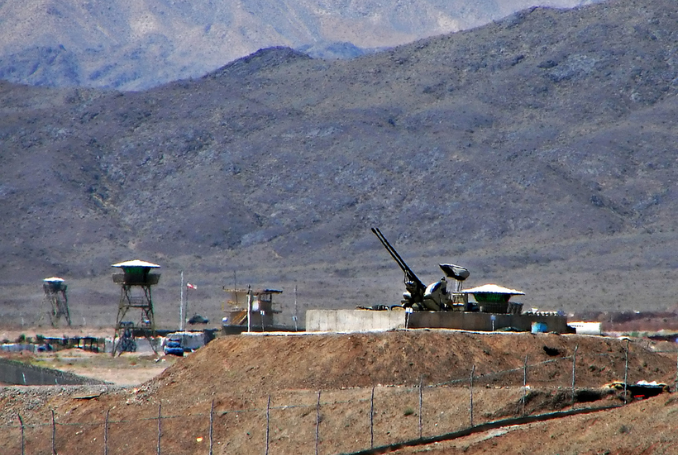

Iran confirmed internal radioactive contamination at the Natanz nuclear facility following an Israeli airstrike, but said no radiation had leaked outside and there was no public risk.
Iran’s Atomic Energy Organization (AEOI) has confirmed that radioactive contamination has been detected inside the Natanz nuclear facility following Israeli airstrikes early Friday morning.
The attack, part of a broader Israeli military operation across Iranian territory, also resulted in the deaths of several senior military commanders and at least six nuclear scientists.
According to AEOI spokesman Behrouz Kamalvandi, the contamination has not spread outside the facility and poses no danger to the public.
“We need to clean up the radiation inside the Natanz facility and then assess the damage,” he said in a televised statement, according to the Tasnim news agency.
Trump Warns Iran as Rubio Denies Role – MAGA Base Slams Israeli Strike
Kamalvandi emphasized that while some surface-level damage occurred at the site, the underground uranium enrichment structures remain intact and there were no casualties in those protected sections.
The Natanz nuclear complex, located in Isfahan Province roughly 220 kilometers southeast of Tehran, is Iran’s main uranium enrichment site.
Built in secret and revealed in 2002, the fortified facility is buried 8 meters underground and shielded by reinforced concrete walls, air defense systems, and Revolutionary Guard security. It has been repeatedly targeted in previous acts of sabotage, including cyberattacks and explosions widely attributed to Israel.
AEOI chief Mohammad Eslami personally inspected the site following the attack and confirmed that the damage was “superficial,” though Kamalvandi noted that “chemical and radiation pollution” had been detected and decontamination efforts are now underway.
The International Atomic Energy Agency (IAEA) has acknowledged that it is monitoring what Director General Rafael Grossi described as a “very worrying situation in Iran.”
Khamenei Vows Harsh Revenge after Israeli Strike Kills Top Iranian Officials
The agency is in communication with both Iranian authorities and IAEA inspectors on the ground to assess any risks stemming from the strike. Grossi confirmed that Natanz was among the facilities targeted.
In addition to Natanz, reports suggest that Israeli strikes also hit a nuclear research center near the city of Tabriz in northwestern Iran.
Iranian officials have not confirmed the extent of the damage at that site, but it is believed to house a research reactor. Meanwhile, Iran has assured the IAEA that the Bushehr nuclear power plant in southern Iran was not targeted.
Rumors have also circulated about possible strikes near the heavily fortified Fordow enrichment facility in Qom province. However, Iranian officials deny any damage there. “The Fordow site is safe and unharmed,” Kamalvandi stated.
Israel Launches Major Airstrikes on Iran, Assassinates IRGC Chief-of-Staff
Beyond nuclear facilities, the Israeli air campaign reportedly struck multiple locations across Iran, including residential neighborhoods in Tehran. Among those killed were top military officials, including:
Major General Mohammad Hossein Baqeri, Chief of Staff of the Iranian Armed Forces
Major General Hossein Salami, Commander of the Islamic Revolutionary Guard Corps (IRGC)
Major General Gholam Ali Rashid, Commander of the Khatam al-Anbia Central Headquarters
Major General Amir Ali Hajizadeh, Commander of the IRGC Aerospace Force
Iran has vowed retaliation. Supreme Leader Ayatollah Ali Khamenei condemned the attack as a major crime and warned Israel of severe consequences.
“With this crime, the Zionist regime has prepared for itself a bitter, painful fate, which it will definitely see,” he declared.
The scale and coordination of the Israeli operation mark one of the most significant escalations in the longstanding shadow war between the two regional powers. While the full extent of damage remains under assessment, both the nuclear and political ramifications of the strike are likely to reverberate for months to come.
(PC, AJA, Tasnim)




I wonder if any of the remaining Iranian Jewish community were also hit. The reports I’ve seen say the IDF attack targeted residential areas as well as military targets – a tradition followed by all powers that rely extensively on airpower. And some Iranian Jews would be relatively high up in the social order – so they stood a fair chance of getting hit as well. That’s one of the lessons of the Lavon Affair – use a very, very long spoon when eating with the Israel government.