
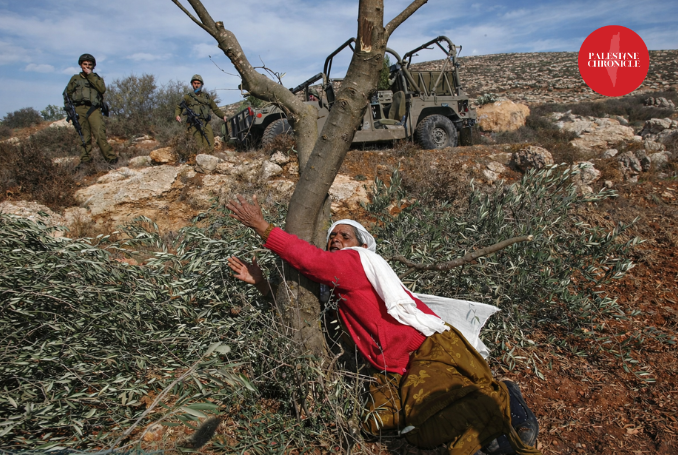

Land Day 2026 reflects destruction and annexation, yet Palestinians remain rooted on their land despite sustained efforts to remove them.
Land Day in Palestine arrives this year at a moment when the very existence of Palestinians on their own land is under direct and unprecedented threat.
What was once understood as a struggle against land confiscation has evolved into something far more urgent: a struggle against erasure itself.
As early as 2012, a report by the United Nations Conference on Trade and Development warned that Gaza could become ‘uninhabitable’ by 2020—a warning later echoed by UN officials, including Robert Piper, who cautioned that living conditions in the Strip were rapidly collapsing.
Today, that projection has not only materialized—it has been overtaken by events – namely the Gaza Genocide.
Large parts of Gaza have been devastated on an unprecedented scale. By early 2026, more than 90 percent of the Strip’s built environment had been damaged or destroyed, with entire neighborhoods erased and critical infrastructure systematically dismantled. Homes, hospitals, water systems, and agricultural lands have been rendered inoperable, leaving vast areas unable to sustain life.
This destruction extends beyond buildings to the very conditions necessary for survival. Water access has collapsed, farmland has been flattened, and essential services have ceased to function. What was once described as a humanitarian crisis has evolved into something far more severe: the transformation of Gaza itself into a space increasingly unable to support human life.
And that is precisely the primary Israeli objective of the genocide.
Indeed, the genocide did not emerge in isolation. It represents the most extreme expression of a long-standing policy aimed at making Palestinian life on the land increasingly difficult, and ultimately untenable.
This same logic is unfolding across the West Bank.
From the northern regions to Hebron (Al-Khalil), land appropriation, settlement expansion, and forced displacement point to a clear trajectory: Israel is accelerating control over land while restricting Palestinian presence on it. Land continues to be reclassified as “state land,” settlements are expanding into new areas, and entire communities face the threat of removal under military and administrative measures.
Israeli officials have become increasingly explicit, and Bezalel Smotrich has been among the clearest. He has called for the “voluntary emigration of Gaza Arabs,” said Israel should “encourage emigration” from Gaza, and argued that Ben-Gurion should have “finished the job” and “thrown out Arabs” in 1948. These are not rhetorical excesses detached from policy. They reflect a political worldview in which Palestinian removal is not a byproduct of Israeli power, but one of its stated aims.
It is against this backdrop that Land Day is commemorated in 2026—not as a historical memory, but as an ongoing reality. A reminder that the struggle for land in Palestine has never ended, and that, despite everything, Palestinians remain rooted in it.
What Is Land Day—and Why Does It Still Matter?
Land Day, commemorated annually on March 30, marks a defining moment in Palestinian history, when the question of land moved from policy into open confrontation.
In 1976, Israel announced the confiscation of thousands of dunams of Palestinian land in the Galilee. Palestinians responded with a general strike and widespread protests across historic Palestine, signaling a collective refusal to accept the continued loss of land. Israeli occupation forces responded with lethal force, killing six Palestinians and injuring and arresting hundreds more.
The significance of Land Day extended beyond the immediate events. It marked the first unified political mobilization of Palestinians inside Israel – historic Palestine – since 1948, establishing land as the central axis of Palestinian identity and resistance. From that moment forward, land was no longer simply a resource tied to livelihood—it became inseparable from existence itself.
That is why Land Day continues to resonate. It is not a commemoration of a single event, but a reflection of an ongoing condition.
What Is Israel Doing to Palestinian Land Today?
The current phase of Israeli policy represents not a departure, but an acceleration of long-standing strategies aimed at consolidating control over land.
Through a combination of legal classifications, administrative measures, and military enforcement, large areas of the West Bank are being absorbed into a system that facilitates settlement expansion. Land designated as “state land” is allocated for Israeli use, while Palestinian access is restricted or entirely denied.
At the same time, illegal settlement outposts continue to expand, often retroactively ‘legalized’ and connected through infrastructure that integrates them into a broader territorial network. Roads, barriers, and checkpoints fragment Palestinian space, making continuity increasingly impossible.
More than 60 percent of the West Bank remains under full Israeli control, and the growing number of checkpoints and restrictions has created a geography defined by separation rather than cohesion.
This is not simply territorial expansion. It is the systematic restructuring of land in a way that renders Palestinian presence increasingly constrained, fragmented, and vulnerable to displacement.
What Is Happening in Gaza—and Why Is It Central to Land Day?
Gaza represents the most extreme expression of the struggle over land, not only because of the scale of destruction, but because of what that destruction signifies.
Entire neighborhoods have been reduced to rubble, and essential infrastructure—water systems, hospitals, electricity networks, and agricultural lands—has been systematically targeted. This is not limited to the visible destruction of buildings; it extends to the erosion of the conditions necessary for life itself.
Agricultural areas have been burned or rendered inaccessible, cutting off sources of food and livelihood. Urban spaces have been flattened to such an extent that reconstruction would require rebuilding not only structures, but the basic systems that allow a society to function. The result is not simply devastation, but transformation.
Gaza is being reshaped into a space where sustained human life becomes increasingly difficult.
This reality was anticipated in earlier international warnings, but its current manifestation is far more severe. The destruction has been accompanied by repeated waves of displacement, with civilians forced to move from one area to another under threat of bombardment.
In this sense, Gaza is not separate from the broader question of land.
It represents its most acute and accelerated form—where the objective is no longer only to control territory, but to render it empty or uninhabitable.
What Are Palestinians Doing in Response?
Despite the scale of pressure, the Palestinian response continues to be defined by persistence.
The concept of sumud, or steadfastness, remains central. Across the West Bank, this is reflected in the daily act of remaining on the land—cultivating fields, rebuilding homes, and maintaining community life under conditions designed to undermine it.
These actions may not always appear dramatic, but they are deeply consequential. Each act of presence challenges the logic of displacement.
In Gaza, where conditions are far more severe, survival itself has taken on this role. Maintaining social bonds, preserving community structures, and continuing daily life under extreme conditions become forms of resistance.
This continuity matters. Because as long as Palestinians remain, the objective of complete removal remains unfulfilled.
What Does Land Day Mean in 2026?
Land Day today is not only a remembrance of the past. It is a reflection of the present and an indication of what lies ahead.
From the Galilee in 1976 to Gaza in 2026, one reality has remained constant: the land is Palestinian, and the struggle has been to defend it, remain on it, and reclaim it despite continuous attempts to seize it.
What has changed is the scale and intensity of the process.
What was once land confiscation has expanded into a broader system of destruction, displacement, and transformation.
And yet, one reality persists. Despite everything—destruction, annexation, and sustained pressure—Palestinians remain on their land.
That, more than anything else, is the enduring meaning of Land Day.
(The Palestine Chronicle)
Be the first to comment