
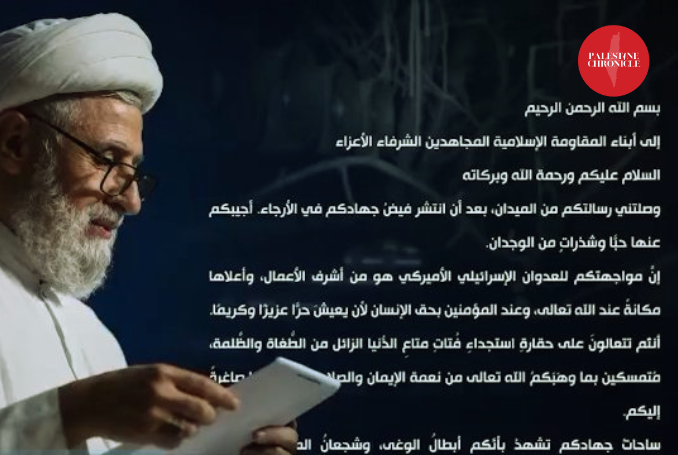

Hezbollah leader Naim Qassem outlines conditions to end the war, linking a ceasefire to withdrawal, prisoner release, and civilian return.
Key Developments
- Qassem said “the battlefield determines the outcome,” stressing continued operations despite sacrifices.
- He said the confrontation exposed Hezbollah’s preparedness, discipline, and operational flexibility across Lebanon.
- He outlined conditions for ending the war, including withdrawal, prisoner release, and return of displaced civilians.
In a message addressed to fighters of the Islamic Resistance, Hezbollah Secretary-General Naim Qassem framed the ongoing confrontation as a decisive battle whose outcome will ultimately be determined on the ground.
“The battlefield is what determines the outcome,” Qassem said, emphasizing that resistance operations will continue “no matter the sacrifices.”
He described the message as a direct response to fighters engaged across multiple fronts, praising what he characterized as the expansion of their efforts and their role in shaping the trajectory of the confrontation.
Qassem placed particular emphasis on endurance, portraying continued engagement in the field as both a military necessity and a defining factor in determining the final outcome of the war.
Operational Depth
Qassem argued that the confrontation with Israel has revealed key elements of Hezbollah’s military capabilities, particularly in terms of preparation, discipline, and strategic planning.
He said the group demonstrated “precise preparation for the battle,” alongside strict adherence to commitments and operational discipline under pressure.
A central point in his message was Hezbollah’s ability to operate without being tied to fixed geographic positions. Qassem stressed that fighters are able to move from different parts of Lebanon to front-line positions, allowing for direct engagement with Israeli forces without relying on static defensive lines.
He also referred to what he described as an “ambiguity of capability,” suggesting that the full scope and limits of Hezbollah’s military strength remain deliberately unclear, both in terms of geographic reach and operational capacity.
Countering Israeli Strategy
Qassem claimed that Hezbollah had succeeded in neutralizing Israel’s strategic advantage, particularly its ability to carry out surprise operations.
He stated that the group had prior knowledge of Israeli plans and was able to prepare accordingly, arguing that this preparation allowed Hezbollah to “invalidate the enemy’s surprise.”
This framing presents the confrontation not as a reactive engagement, but as one in which Hezbollah has maintained a level of strategic awareness and readiness that prevented Israel from achieving its intended outcomes.
Conditions for Ending the War
On the political level, Qassem outlined what he described as the only viable framework for ending the confrontation.
He stated that any resolution must include “stopping the aggression, withdrawal from occupied lands, the release of prisoners, and the return of displaced civilians,” alongside the beginning of reconstruction efforts.
These conditions, he suggested, are both necessary and achievable, presenting them as a clear alternative to continued escalation.
Ideological Framing
Beyond the military and political dimensions, Qassem framed the confrontation as part of a wider moral and ideological struggle.
He described the ongoing conflict as a response to Israeli and American actions, while also criticizing what he characterized as Western complicity.
In his message to fighters, Qassem praised their role in confronting what he called “Zionist aggression” and “American tyranny,” presenting their actions as part of a broader effort rooted in principles of resistance and dignity.
He emphasized that fighters remain committed despite the scale of destruction and loss, portraying their endurance as a central component of the confrontation.
‘The Battlefield Will Decide’
Qassem also invoked religious symbolism, linking the current confrontation to historical narratives of sacrifice and steadfastness.
He framed the struggle as one defined by a choice between “dignity and submission,” reinforcing the idea that continued resistance is both a moral and strategic imperative.
The message included references to past figures and leaders, presenting the current confrontation as part of a longer trajectory of resistance and continuity.
Qassem also stressed that sacrifices made during the conflict—including those killed, wounded, or captured—form part of what he described as a broader foundation for sustaining the movement and achieving its objectives.
Concluding his message, Qassem reiterated that the outcome of the confrontation will ultimately be determined through continued engagement on the ground.
He expressed confidence that sustained operations, combined with what he described as faith and resilience, would shape the final result.
“The battlefield is what determines the outcome,” he repeated, framing the ongoing confrontation as one that remains open-ended, but firmly rooted in the dynamics of the field rather than political negotiation alone.
(Al-Manar, Al Mayadeen, PC)




Be the first to comment