
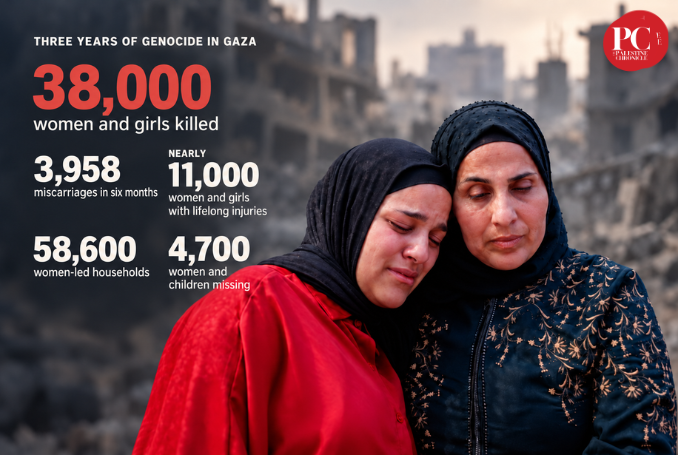

Three years of Israeli genocide have killed thousands of Gaza’s women and girls while pregnancy, childbirth, and survival become dangerous.
Key Developments
- UN Women estimated that more than 38,000 women and girls were killed between October 2023 and December 2025.
- Gaza recorded 3,958 miscarriages during the first half of 2026, with the miscarriage rate rising more than threefold.
- The war has left 58,600 households headed by women amid widespread displacement, hunger and the loss of family incomes.
Three years into Israel’s genocide in the Gaza Strip, Palestinian and UN data reveal devastating consequences for women and girls, including mass killings, lifelong injuries, miscarriages, unsafe births, malnutrition and the loss of essential health care.
The destruction of Gaza’s health system has deprived pregnant women of prenatal care and safe delivery services, forcing some to give birth inside homes or displacement shelters without trained medical assistance.
At the same time, the killing, injury and disappearance of men have transformed family structures, leaving tens of thousands of women solely responsible for supporting their households under conditions of displacement, poverty and famine.
Thousands Killed
Data released by the Palestinian Central Bureau of Statistics on July 18 showed that 12,400 women, excluding girls, had been killed in Gaza since October 7, 2023.
Women and children also accounted for 4,700 of the 11,200 Palestinians reported missing, the bureau said. The fate of many remains unknown amid fears that they are buried beneath buildings destroyed by Israeli attacks.
A broader assessment published by UN Women in April estimated that more than 38,000 women and girls were killed between October 2023 and December 2025—an average of nearly 47 every day.
“There are close to 11,000 women and girls with lifelong injury,” the report, titled The Cost of War on Women and Girls, said.
More than 71,200 Palestinians were killed during the period covered by the UN Women report. Women, children and older people together represented more than half of all documented fatalities.
The organization cautioned that the actual number of deaths was higher because of “the collapse of health information and reporting systems.”
Women and children accounted for nearly two-thirds of documented fatalities during the first six months of the Israeli assault, the highest proportion recorded throughout the genocide.
Despite the ceasefire that took effect on October 10, 2025, women and girls have continued to be killed and wounded, while the humanitarian and medical conditions threatening their lives have shown no significant improvement.
Israeli Strike Kills Christian Mother and Daughter, Academic, Her Mother in Gaza
Reproductive Health System
Attacks on hospitals, repeated displacement, severe hunger and the denial of medical supplies have caused a sharp deterioration in reproductive health across Gaza.
In July 2024, the International Planned Parenthood Federation reported that miscarriages had increased by at least 300 percent during the first nine months of the genocide.
Physicians for Human Rights documented 2,600 miscarriages during the first half of 2025 in its January 2026 report, Destroying Hope for the Future: Reproductive Violence in Gaza.
The organization also recorded 220 pregnancy-related deaths and 1,460 premature births during that period, while more than 2,500 newborn babies required intensive care.
Gaza’s Health Ministry separately found that 57.1 percent of registered pregnant women suffered from anemia in 2025.
The shortages of food, clean water, medicines and medical equipment have increased the danger of low birth weight, premature delivery, stillbirth and maternal death.
Four Women Among Five Killed in Gaza Strike as WHO Condemns Medical Aid Delays
Giving Birth outside Hospitals
Pregnant women have faced growing difficulty obtaining prenatal care, emergency treatment and safe delivery services as Gaza’s hospitals have been attacked, destroyed or deprived of the resources needed to function.
UN Women said Gaza was recording approximately 130 births per day as of March 2025. More than one-quarter were delivered by cesarean section, adding further pressure to the collapsing health system.
Many women were forced to give birth at home or inside displacement camps, far from emergency medical care.
Even after the ceasefire took effect, approximately 15 births continued to take place outside hospitals every week, frequently without trained midwives or adequate sanitation.
By July 2025, 40 percent of pregnant and breastfeeding women in Gaza were suffering from malnutrition, while approximately half a million women and girls faced the threat of famine.
UN Women estimated that 37,000 pregnant and breastfeeding women, together with 50,000 girls, would require treatment for acute malnutrition during the year following the ceasefire.
In a separate report issued on June 19, 2026, the organization said 1 million women and girls lacked access to clean water, 690,000 were living in overcrowded shelters and 328,000 girls remained out of school.
Gaza’s Breast Cancer Crisis Deepens as Screening and Treatment Systems Collapse
Miscarriages More than Triple
The latest figures from Gaza’s Health Ministry indicate that the reproductive health crisis has continued despite the ceasefire.
The ministry recorded approximately 3,958 miscarriages between January and June 2026.
An infographic published by the ministry on July 20 showed that the miscarriage rate reached 208.5 for every 1,000 live births during the first half of 2026.
That compared with 64 miscarriages for every 1,000 live births during the second half of 2025, meaning the rate had risen approximately 3.3-fold.
April recorded the highest monthly miscarriage rate, at 377.25 for every 1,000 live births. June recorded the largest number of miscarriages, with 790 documented cases.
According to the ministry, 73.6 percent of miscarriages occurred during the first trimester, before the completion of 13 weeks of pregnancy. Another 26.4 percent occurred during the second trimester, between 13 and 24 weeks.
Palestinian Detainee Gives Birth in Israeli Prison after Six Months without Charge
Burden of Survival
The genocide has also forced growing numbers of women to become the sole providers and caregivers for their families following the killing, injury or disappearance of their husbands.
According to UN Women, the proportion of households in Gaza headed by women increased from 9 percent before the war to 14 percent.
An estimated 58,600 households are now headed by women as a direct result of the war.
The shift has imposed long-term economic and social burdens on women already struggling with displacement, poverty, hunger, bereavement and the loss of family income.
Women and girls also continue to face heightened protection risks inside overcrowded shelters and displacement camps where clean water, sanitation, privacy and medical services remain severely limited.
Israel has continued violating the ceasefire that took effect on October 10, 2025. Israeli attacks had killed 1,460 Palestinians and wounded 5,116 others through Monday, according to Gaza’s Health Ministry.
Since October 2023, Israel has killed more than 74,000 Palestinians and wounded over 175,000 others in Gaza. Approximately 90 percent of the enclave’s infrastructure has been damaged or destroyed.
(PC, Anadolu, UN Women, Palestinian Central Bureau of Statistics, International Planned Parenthood Federation, Physicians for Human Rights, Gaza Health Ministry)


Be the first to comment