
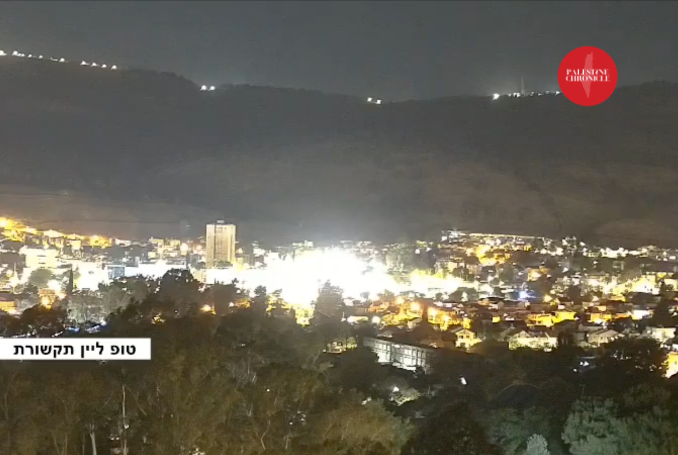

Hezbollah intensified attacks on northern Israel, targeting Kiryat Shmona and Meron as reports point to a new strategy.
Key Developments
- Hezbollah launched rocket salvos at Kiryat Shmona and the Meron military base.
- Israeli media reported a missile landing in central Kiryat Shmona.
- Israeli outlets said Hezbollah has increased the pace and depth of its attacks.
- Israeli health data showed thousands of casualties since the start of the regional war.
Missile Lands in Kiryat Shmona
The Lebanese resistance movement Hezbollah announced a new series of operations targeting northern Israel early Saturday, launching rocket salvos toward the settlement of Kiryat Shmona and the Meron base, one of Israel’s key military facilities for monitoring and managing aerial operations in the Upper Galilee.
According to a statement issued by Hezbollah, fighters targeted Kiryat Shmona with two separate rocket barrages at dawn before launching what the movement described as a “qualitative” rocket salvo against the Meron base in northern occupied Palestine.
The attacks came amid continued exchanges of fire across the Lebanese border and ongoing Israeli violations of the ceasefire agreement that entered into force in April.
Israeli media confirmed that rockets launched from Lebanon reached the targeted areas.
Israel’s Channel 12 reported that one missile landed in the center of Kiryat Shmona.
Other Israeli media outlets said Hezbollah had increased the pace of its attacks, describing the latest operations as part of a broader escalation that included nighttime rocket barrages toward Kiryat Shmona and areas throughout the Galilee.
Israeli Army Radio reported that Hezbollah had expanded the geographical scope of its attacks, noting that Saturday’s strikes reached the Meron area deep inside the Upper Galilee.
The Meron base is considered one of Israel’s most significant military installations in the north and plays a central role in surveillance, intelligence gathering and the management of aerial operations.
🚨 Israeli Army Radio: Sirens were triggered in four separate waves overnight and this morning across several northern settlements, including Kiryat Shmona and Metula. Hezbollah also launched rockets deeper into northern Israel, targeting the Meron area.
A rocket from Lebanon… pic.twitter.com/s68eRcLbFQ
— The Palestine Chronicle (@PalestineChron) May 30, 2026
Israeli Casualties Continue to Rise
Hezbollah said the operations were carried out in response to continued Israeli violations of the ceasefire agreement and ongoing attacks against towns and villages in southern Lebanon.
The movement has repeatedly stated that its military operations are linked to Israeli strikes that have killed and wounded Lebanese civilians despite the truce.
Since the ceasefire came into effect, Israeli warplanes, drones and artillery have continued to conduct attacks across southern Lebanon, while Hezbollah has maintained what it describes as retaliatory operations against Israeli military positions, troop concentrations and settlements.
The latest attacks came as new Israeli figures highlighted the growing human cost of the conflict.
The Israeli Ministry of Health announced five additional casualties, bringing the total number of injuries recorded since the outbreak of the American-Israeli aggression on Iran to 8,909.
According to the ministry, 1,008 of those injuries were recorded on the Lebanese front alone during the period following the ceasefire agreement reached after the Iran-Israel confrontation.
Separate official figures showed that since the ceasefire in Lebanon was announced on April 17, Israeli hospitals have treated 593 casualties linked to attacks originating from the northern front.
The figures reflect the continuing impact of Hezbollah’s operations despite repeated Israeli claims that the movement’s capabilities have been significantly degraded.
Hezbollah Announces Tank Strikes as Israeli Pressure Mounts over Lebanon War
New Hezbollah Strategy
Meanwhile, an assessment issued by the Israeli Amit Information and Intelligence Center suggested that Hezbollah has recently adopted what it described as a “new operational strategy.”
According to the report, the movement has increasingly shifted its focus toward targeting Israeli military commanders and leadership figures active along the Lebanese border and inside northern occupied Palestine.
The assessment noted a growing emphasis on intelligence-driven operations aimed at command structures rather than solely targeting military infrastructure or troop gatherings.
The report comes amid a series of recent Hezbollah operations involving drones, precision-guided weapons and attacks directed at military vehicles and command positions.
Israeli analysts have increasingly warned that Hezbollah’s evolving tactics reflect lessons learned from months of confrontation and indicate an effort to raise the cost of Israeli military operations in both southern Lebanon and northern occupied Palestine.
(PC, Al Mayadeen, Hezbollah military media)





Be the first to comment